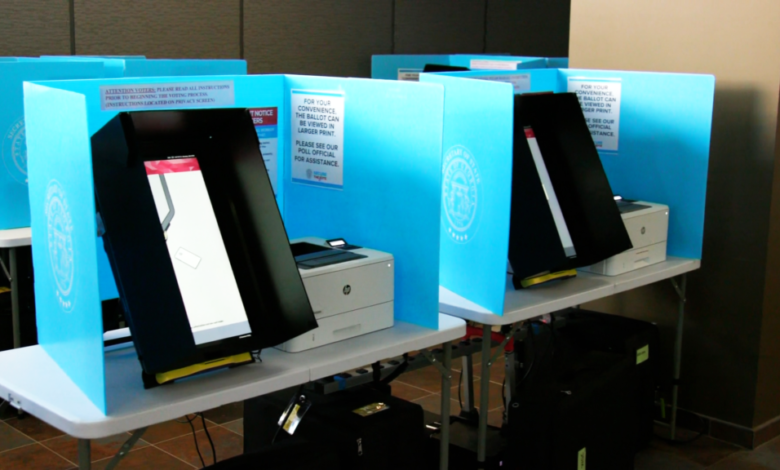
In a small warehouse in Paulding County, Georgia, about an hour west of Atlanta, election workers are unpacking voting machines and conducting rigorous logic and accuracy tests. This meticulous preparation is part of a statewide protocol as local officials ready polling locations and ballot scanners for upcoming midterm elections.
Everything inside the Paulding County election headquarters is carefully organized, including the Dominion Voting Systems ballot scanners, each secured and locked in six different places to prevent tampering. Following the intense scrutiny and conspiracy theories that emerged after the 2020 presidential election, Georgia election officials have increasingly invited the press and the public directly into their offices to observe checks and balances in action.
Lacy Dunn, the assistant elections director in Paulding County, acknowledged the climate surrounding the state’s voting procedures. “We know that Georgia’s — it’s in the news. And so we are very prepared,” Dunn said.
Overseeing the statewide apparatus is Republican Secretary of State Brad Raffensperger, who has held the office for eight years and maintains daily contact with officials across Georgia’s 159 counties to manage training and oversight. Raffensperger became a national figure for refusing to assist former President Donald Trump in overturning the state’s 2020 election results, famously rebuffing a call in which Trump asked him to find 11,780 votes.
Tensions surrounding the 2020 election persist. In January of this year, FBI agents raided the Fulton County election headquarters, seizing hundreds of boxes of election materials while the director of national intelligence was present. Nearly nine months after that unprecedented seizure, the FBI has yet to bring criminal charges.
Meanwhile, Trump has continued to view Georgia as central to claims that the 2020 election was stolen, fueling enduring skepticism among some local voters. In response, Raffensperger is pushing back against ongoing efforts by federal authorities to exert greater control over the state’s voting procedures.
Georgia, alongside 30 other states, recently refused to turn over sensitive voter information to the Department of Justice. Raffensperger explained that the federal government requested personal identifying information, including full dates of birth and Social Security numbers.
“I provided the federal authorities everything we could by state law,” Raffensperger said. “And state law says you cannot hand out the information that they wanted. What they wanted was Social Security numbers, date of birth, full date of birth. And that is PII, your personal identifying information. And that’s just something by state law we were not allowed to do. And so we — that was where we placed the guardrail on that.”
Georgia law already mandates voter identification, and Raffensperger highlights a recent audit showing the state’s voter rolls are 99.8 percent accurate, asserting that widespread noncitizen voting is not an issue in the state. He contends that every state should conduct citizenship audits and match Georgia’s diligent verification efforts.
Yet internal friction remains within the state’s administration. The secretary of state’s office has repeatedly clashed with the Georgia State Election Board, a body with limited operational power but a prominent public voice. Salleigh Grubbs, a state election board member and former chair of the Cobb County Republican Party, was appointed late last year by the Republican lieutenant governor and continues to question Fulton County’s handling of the 2020 vote.
Grubbs points to instances of double and triple counting in Fulton County during the 2020 election, arguing that the system remains compromised. While a state investigation into Fulton County’s results confirmed that ballot double counting occurred during a recount, the review attributed the discrepancies to human error rather than intentional misconduct and concluded the errors were not enough to alter the outcome.
The most recent flash point between the state board and the secretary of state’s office centers on Georgia’s touch-screen voting machines, manufactured by Dominion Voting Systems, which print voter selections on paper ballots containing QR codes for tabulators. The election board has urged state officials to assist the Justice Department in investigating the equipment.
Grubbs expressed deep distrust in the hardware, arguing that vulnerabilities must be mitigated. In response, Raffensperger’s office maintains that the machines are secure, noting that election officials utilize established processes to ensure ballot secrecy and planning to replace the aging Dominion equipment by 2028. Dominion Voting Systems, now known as Liberty Vote, defended its hardware in a statement, emphasizing that years of scrutiny have consistently affirmed the accuracy, security, and reliability of its systems.
Despite her concerns regarding noncitizen voting and equipment security, Grubbs stated that she will accept the results of the upcoming election if issues are properly investigated. Timeliness and accuracy remain the core goals for Raffensperger’s administration as it seeks to reinforce public confidence across the state before voters return to the polls.