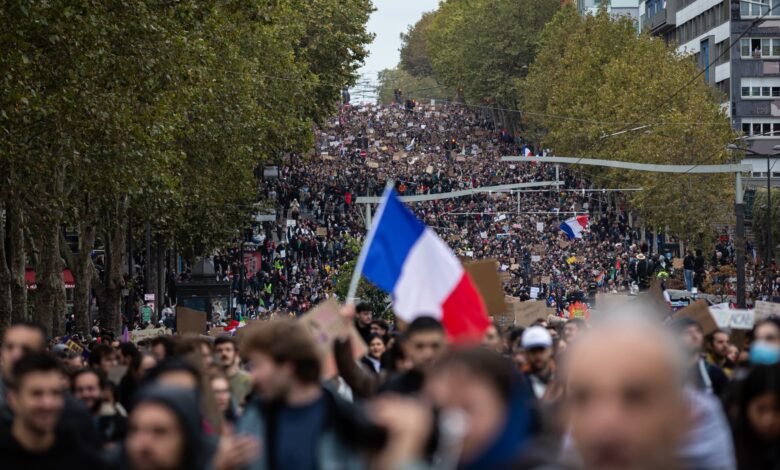
Mass protests and nationwide demonstrations across France have intensified investor anxiety regarding the country’s fiscal stability, driving borrowing costs to their highest level in over two decades. The unrest follows large-scale weekend rallies that drew hundreds of thousands of participants to city centers, where largely peaceful marches occasionally gave way to clashes with security forces in Paris and Marseille despite extensive police deployments.
The Interior Ministry reported that 410,000 individuals participated in demonstrations nationwide, while labor unions estimated the turnout at twice that figure. Amid the ongoing turmoil, credit rating agency Moody’s maintained its Aa3 credit rating for France, classifying it as high grade, but kept its negative outlook intact. The agency cited the persistent risk that political fragmentation within the country’s legislative institutions will continue to impair governance and budget implementation.
Financial markets have reacted sharply to the sustained disruption. The yield on benchmark 10-year French government bonds, known as OATs, climbed 11 basis points, pushing borrowing costs to levels not seen since 2002. This movement widened the yield spread over 10-year German Bunds—the baseline for euro zone debt—to its widest margin since November 2011. Fund managers note that recent pressure on French sovereign debt stems largely from tactical portfolio reallocations, with traditional buy-and-hold investors largely remaining on the sidelines.
Economists warn that the ongoing civil friction threatens France’s growth trajectory and its ability to achieve targeted budget savings. The government aims to reduce its budget deficit to 5% of gross domestic product by 2027, down from a projected 5.4% in 2026. The National Assembly is scheduled to resume debates on tax measures intended to generate these savings, but opposition lawmakers are strongly resisting the proposals. Analysts suggest the government may attempt to enforce fiscal targets by invoking Article 49.3, which permits the passage of bills without a final assembly vote unless a no-confidence motion succeeds, or by utilizing executive ordinances.

Market strategists remain skeptical about the legislative outlook. It remains unclear whether the 2027 budget will successfully clear parliament, and even if it does, analysts suggest it may be heavily diluted by concessions to political factions, leaving the core deficit problem inadequately addressed. This political friction compounds existing economic headwinds. Economic forecasters project modest GDP growth of 0.3% for 2026 and 0.6% for 2027, warning that continued unrest, deteriorating consumer confidence, and heightened market tensions could suppress growth even further. Historical comparisons cited by analysts indicate that prior social unrest, such as the 2018 Yellow Vest movement and the spring 2023 pension protests, shaved approximately 0.1 percentage point from quarterly GDP growth.
Sector-specific impacts are becoming increasingly evident as the CAC 40 index has declined 4.5% over the past month. Financial institutions note that retail, hospitality, tourism, and transport logistics are the most directly exposed segments of the economy. Shops and commercial centers report diminished footfall and closures, while the hotel and restaurant sector faces permanent losses in activity as consumers cancel or postpone plans. Furthermore, transport and logistics operations risk severe bottlenecks if industrial action persists.

Corporate reactions reflect the growing macroeconomic strain. Supermarket operator Carrefour saw its shares drop more than 14% after slashing its profit outlook and curtailing investment plans, pointing to the combination of social unrest and rising energy costs as significant drags on consumer sentiment. According to estimates from France’s network of chambers of commerce, more than 2,000 businesses had sustained direct impacts by early in the week. Financial advisors indicate that the fallout extends into the banking sector, where higher equity costs and prolonged uncertainty threaten to slow loan growth and generate credit risks.
Even sectors with substantial international exposure are feeling the effects. France’s luxury goods industry, which generates the vast majority of its revenue abroad, faces risks tied to domestic tourism. For example, LVMH derives only 8% of its revenue directly from the domestic French market, but tax-free purchases by tourists account for roughly 20% of its sales within the country. With further demonstrations and union-backed national strikes scheduled for upcoming weeks, market participants warn that a prolonged political vacuum could weigh heavily on economic activity, business investment, and consumer sentiment for months.