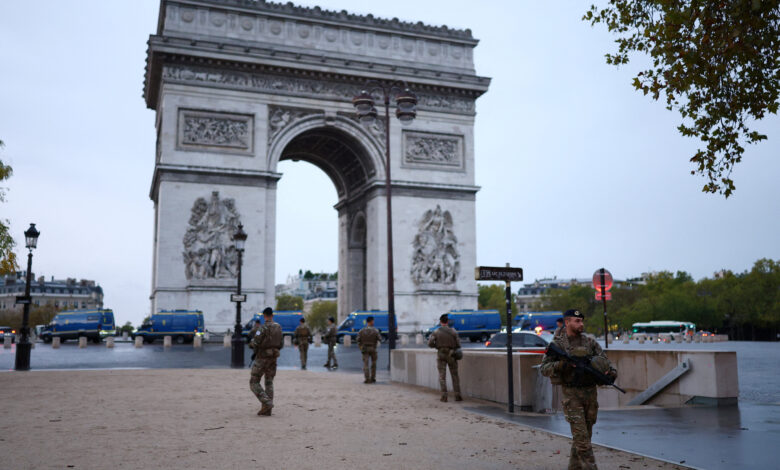
French security forces established a massive perimeter across Paris on Saturday as authorities braced for a wave of nationwide demonstrations that officials fear could descend into localized violence and looting. Interior Minister Laurent Nunez has ordered a high-readiness posture, mobilizing 70,000 police and gendarmerie officers across the country to contain a movement fueled by rising living costs and political friction.
The deployment on Saturday represents a significant escalation in the government’s security response, with 10,000 more officers in the field than during the demonstrations on October 17. That previous weekend saw widespread vandalism and theft, leading to intense scrutiny of the government’s ability to protect the capital’s commercial and cultural hubs.
In Paris, the atmosphere was marked by the presence of the “Sentinelle” anti-terrorism military unit. Soldiers in full tactical gear patrolled the Champs-Elysees and the areas surrounding the Arc de Triomphe. Interior Minister Nunez, speaking directly to officers on the ground, warned of a “long day” ahead. He urged units to be “hyper-reactive” and “ultra responsive,” noting that authorities had identified credible threats from both organized political agitators and opportunistic criminal groups looking to target public institutions and retail businesses.
The capital essentially entered a partial lockdown ahead of the marches. Many luxury retailers and smaller shopkeepers spent Friday evening and Saturday morning boarding up storefronts. Business associations had previously advised stores to remain shuttered after thousands of businesses were damaged in the unrest of mid-October. The city’s cultural life also ground to a halt, with the Louvre, the Musée d’Orsay, and the Opera House all closing their doors to the public. Additionally, more than 20 metro stations were taken out of service as a security precaution.
A central point of contention on Saturday morning was the designated route for the main Paris march. Police authorities sought to redirect organizers away from the high-traffic city center, citing the “high concentration of businesses” that were targeted in previous riots. Instead, the prefecture ordered the march to move toward the southeastern fringes of the capital. This last-minute shift drew sharp criticism from hard-left leader Jean-Luc Melenchon, who accused the government of intentionally creating disruption and setting impossible deadlines for organizers to reorganize their logistics.
While the “Yellow Vests” and student groups are primarily protesting the cost of living and fuel prices, the demonstrations have taken on various political dimensions in other parts of the country. In Orleans, roughly 75 miles south of Paris, a march began mid-morning to protest a congress being held by Marine Le Pen’s National Rally party. Bally Bagayoko, the mayor of Saint-Denis and a member of the France Unbowed (LFI) party, said the Orleans gathering was intended to confront the far right directly.
Elsewhere, the legal status of the protests remained a patchwork of bans and authorizations. While Marseille reversed an earlier prohibition to allow a union march and Strasbourg permitted rallies to proceed, central Lyon remained under strict restrictions. Protests were banned entirely in a string of other cities, including Nancy, Metz, Rouen, Le Havre, Toulon, and Limoges.
Public anxiety has been further heightened by a violent incident west of Paris on Friday. A gunman, suspected of being motivated by Islamophobic hatred, opened fire in an attack that left one person dead and four others wounded, including a 12-year-old girl. This event, combined with the memory of the looting that shook the country on October 17 and 18, has left the government under immense pressure to maintain order as the protests continue to evolve.