Paris entered a state of high security on Saturday as the French government deployed 70,000 police officers nationwide and shuttered world-renowned museums to contain a swelling national protest movement. What began last month as a localized dispute over staff shortages at a single high school has evolved into a broad rebellion against soaring living costs and the perceived decline of the nation’s education system.
In Paris, the atmosphere was one of tense preparation. Gendarmes stood guard beneath the Arc de Triomphe while shopkeepers across the capital scrambled to board up storefronts. Akram Ahmed, a 34-year-old contractor, spent Saturday morning securing an optician’s shop near the Saint-Lazare train station. He noted the desperation of business owners who felt their livelihoods were at risk after a previous weekend of unrest saw 3,000 shops across France damaged or looted.
Interior Minister Laurent Nuñez mobilized helicopters, armored vehicles, and water cannons to support the massive ground deployment. The scale of the response follows a week of intense pressure on the government; Nuñez recently offered his resignation after acknowledging that police lost control in several cities during previous demonstrations, though President Emmanuel Macron refused to accept it.
International tourism and the arts took a direct hit as the Louvre, Orsay Museum, Picasso Museum, and the Grand Palais remained closed to the public on Saturday. Art Basel, a prestigious contemporary art fair, was forced to cancel its weekend program after only one day of operation. In an attempt to manage the crowds, Paris authorities restricted the main march to the city’s southeastern edge, rerouting the procession between Porte d’Italie and Porte de Vincennes. Police used megaphones at the Bastille—the original planned starting point—to warn that any person remaining in the area would face a 135-euro fine.
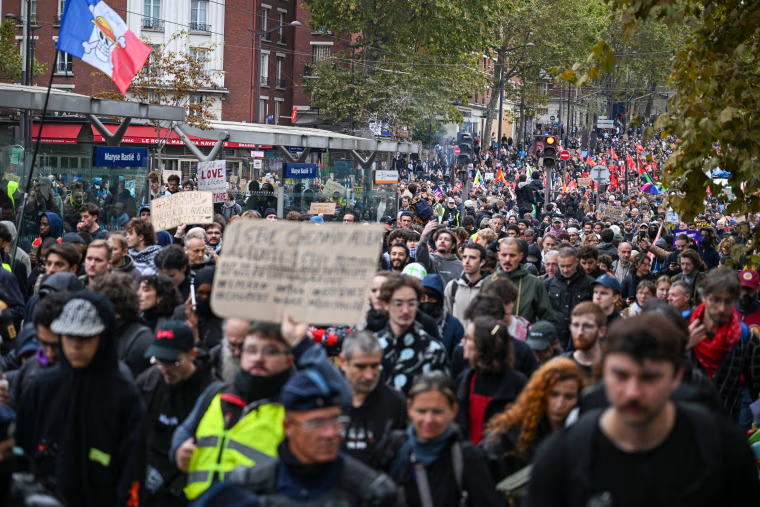
While the Paris march remained largely contained early in the afternoon, clashes erupted in other regions. In Lyon, where the local government had banned rallies, police used tear gas to disperse crowds on Saturday morning. Similar scenes unfolded in Clermont-Ferrand, where French media reported that officers used tear gas and stun grenades to prevent demonstrators from reaching the city center. Meanwhile, in Orléans, a separate peaceful protest took place against the far-right National Rally party, which was holding a two-day congress in the city led by Marine Le Pen.
The unrest is fueled by a combination of economic hardship and a crisis in public services. According to the national statistics agency INSEE, energy prices in France were 21.3% higher in September compared to the previous year, pushing overall inflation to 3.1%. These figures have amplified the demands of trade unions and student groups who argue that the working class is being squeezed while wealth remains concentrated in too few hands.
Education remains a central pillar of the grievance. Student groups are currently demanding the creation of 250,000 new places in higher education and the abolition of Parcoursup, the national university admissions system. They have presented a 10-point plan calling for more teachers and urgent repairs to aging school infrastructure. Data from the Education Ministry indicates that public middle and high schools lost 15.4 million teaching hours during the 2024-2025 school year because absent teachers were not replaced—representing 7.5% of all scheduled instruction time.
To mitigate the cost-of-living crisis, student representatives are also seeking a 200-euro monthly increase in grants and a rent freeze on public student housing. President Macron met with high school representatives on Friday to discuss these issues. While student leaders said the president promised to overhaul university admissions, they maintained that the protests would continue until the government announces concrete, funded measures.
Trade unions have expressed sharp criticism of the government’s tactics, particularly the banning of rallies in cities like Nice and Montpellier, calling the moves a violation of the constitutional right to freedom of expression. Soumaya Abed, a 58-year-old nurse and union member, noted that in 30 years of activism, she had never seen authorities force a march to start at the city’s edge. She characterized the security measures as an attempt to quiet the movement by using previous violence as an excuse.
President Macron enters the final months of his current term with his popularity at its lowest point since he took office in 2017. While he has defended the heavy police presence and route changes as necessary to protect businesses and public buildings, the persistent turnout suggests the movement has become a significant challenge to his administration’s final policy goals.