
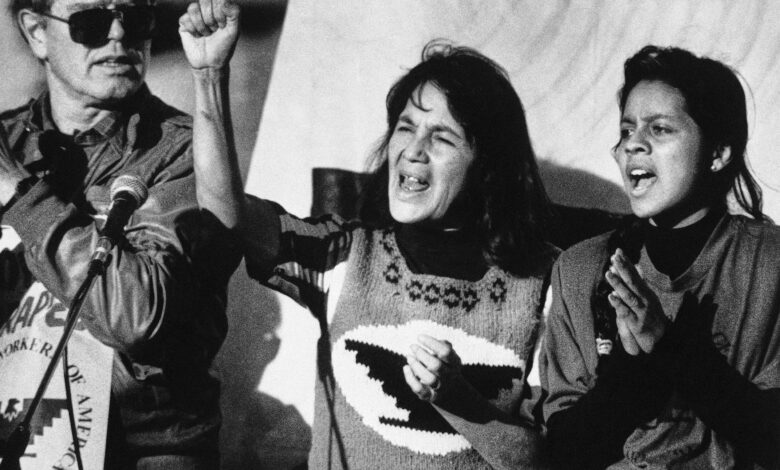
Dolores Huerta, a towering figure in American labor history who co-founded the United Farm Workers union and coined the enduring civil rights slogan “Sí, se puede!”, has died at the age of 96. Her family announced her passing in a statement issued through her foundation, stating that she died Wednesday at her home.
Born in New Mexico and raised by a single mother in California’s San Joaquin Valley, Huerta initially worked as a school teacher before dedicating herself to social justice. She helped found a local chapter of a grassroots organization that fought against segregation and police brutality before turning her focus toward the plight of agricultural laborers. Alongside César Chavez, she established the organization that eventually grew into the United Farm Workers of America.
Her decades of advocacy made her one of the nation’s most prominent civil rights icons, feminist activists, and labor leaders. Her famous three-word Spanish slogan—which translates to “Yes, it can be done”—was born from a deep-seated conviction that ordinary people could enact meaningful social change. The phrase later crossed into broader political culture, inspiring countless movements and famously being adapted by Barack Obama for his 2008 presidential campaign. When Obama presented Huerta with the Presidential Medal of Freedom, the nation’s highest civilian honor, in 2012, he praised her tenacity and acknowledged borrowing her rallying cry.
Throughout her life, Huerta maintained a complex personal legacy intertwined with the movement she helped build. She had seven children from two earlier marriages and later shared her life with Richard Chavez, César’s brother, beginning in the early 1970s. Together, Huerta and Richard Chavez had four children.
Earlier this year, Huerta stunned activist circles and the Latino community by publicly disclosing that she had been sexually abused in the 1960s by César Chavez, resulting in the birth of two children. She kept the secret for six decades, long after Chavez’s death, explaining that she remained silent out of fear that speaking out would undermine her life’s work and jeopardize the progress achieved for farm workers. Despite the profound personal revelation, she continued to urge people to stand firm in their fight for justice.
Even in her mid-90s, Huerta remained active on the national stage, marching and speaking across the country on issues concerning poverty, race, and women’s rights through her California-based Dolores Huerta Foundation. Her decades of service earned her numerous accolades, cementing her legacy as a foundational architect of modern American labor and civil rights advocacy.
