Across the logistics sector, a common consumer practice has inadvertently become a financial trap for delivery personnel. Couriers frequently urge customers to communicate via private messages rather than contacting official support lines because any inbound customer call routed through corporate systems can trigger severe internal performance penalties and fines. According to industry insiders, a single customer inquiry that is automatically logged can set off a chain reaction of deductions stretching from corporate headquarters down to local franchise stations and individual workers.
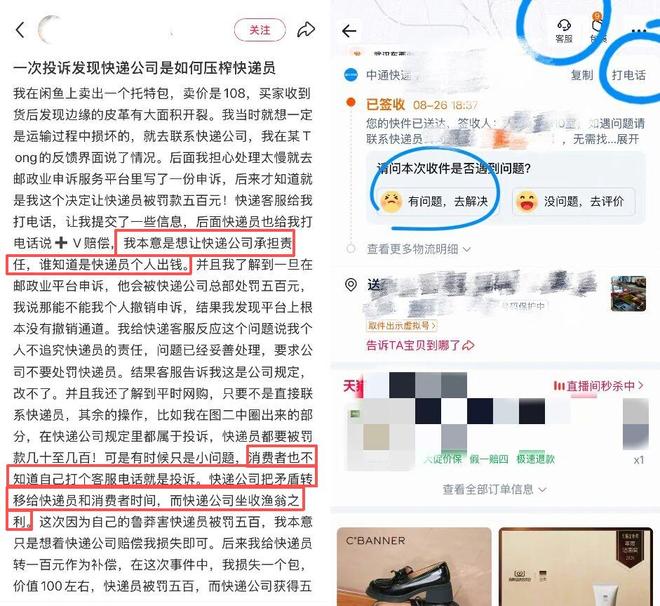
The mechanics of these automated systems often fail to distinguish between routine inquiries and actual grievances. Consumers who call customer service simply to ask about changing delivery times, modify a shipping order, or seek general information find that their interactions are routinely recorded as negative complaint tickets. In some cases, even when customers attempt to follow up and cancel a prior complaint, the subsequent contact is classified as a secondary infraction, leading to compounded financial penalties for the courier involved. Fines for a single recorded complaint frequently range from 100 to 200 yuan.

This administrative framework is deeply rooted in the franchise model prevalent across major delivery networks, which include brands like Yunda, Yuantong, and Shentong. Corporate headquarters impose strict performance metrics on regional sorting and delivery stations. A local station handling thousands of parcels daily can see its base delivery fee per package reduced if it accumulates only a handful of inbound customer calls, wiping out daily profits. Operating under thin profit margins and facing financial pressure from headquarters, local stations frequently rely on fines as a low-cost management and risk-mitigation tool, passing the financial burden directly onto frontline workers.
The human cost of this automated management style has manifested in direct friction between workers and the public. In Hangzhou, a seven-month pregnant woman named Liu experienced an unexpected confrontation when a courier arrived at her home visibly distressed. The worker accused her of lodging complaints that threatened to wipe out his entire daily earnings of 200 yuan after two service tickets were logged against him. Liu had merely called customer support to cancel an order and ask a routine question. In another incident in Beijing, a consumer named Tong was approached by an agitated courier pounding on his door after a retail merchant lodged a grievance against the logistics service, creating an erroneous internal ticket that the worker blamed on the consumer.

Legal and public administration experts attribute these recurring conflicts to structural imbalances within platform economies. Labor law specialist Huang Lepin noted that couriers occupy a vulnerable position relative to corporate platforms, often lacking the bargaining power to challenge automated rules or voice objections without risking severe retaliation or exclusion. Automated processing systems lack necessary human review and grievance mechanisms, reducing complex consumer interactions to rigid data metrics that penalize frontline staff without offering pathways for clarification.
Beijing University government management professor Ma Liang observed that such practices reflect a broader trend of rudimentary, one-size-fits-all management across platform-based industries including delivery, ride-hailing, and e-commerce. By shifting administrative costs downward and avoiding labor-intensive human oversight, companies achieve operational efficiency while transferring the social and financial burden onto workers and consumers alike. This dynamic not only alienates the workforce but also risks eroding public trust, leaving room for potential abuse by individuals who might exploit automated rules to manufacture grievances.
Regulatory bodies have begun pushing back against such management practices. Early in the year, postal authorities called for comprehensive efforts to curb excessive industry competition, rebalance利益 distributions among corporate headquarters, franchisees, and couriers, and eliminate unreasonable administrative penalties. Experts emphasize that meaningful reform requires external regulatory oversight to target abusive algorithmic terms and ensure that platform enterprises assume greater corporate responsibility for worker welfare.