Defense Intelligence Agency Releases Clearest Public Photograph of China’s Secretive Shenlong Space Plane

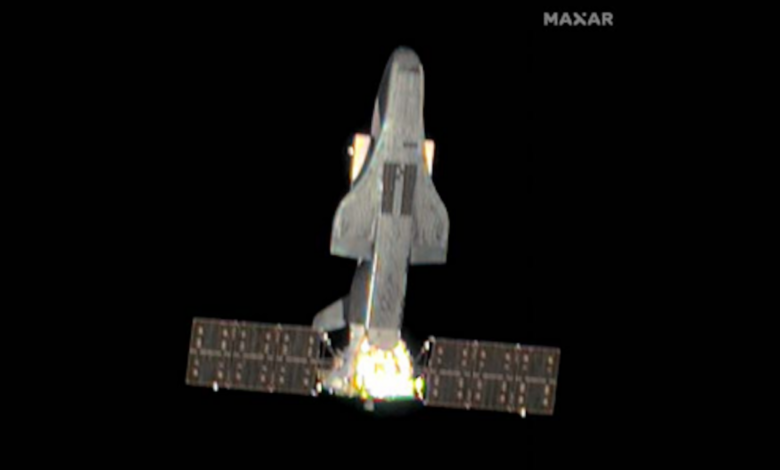
The Defense Intelligence Agency has published what is publicly the clearest image yet of Shenlong, China’s highly classified reusable space plane. Captured in 2024 by geospace intelligence firm Maxar Technologies, the unclassified photograph appears on page 53 of the DIA’s latest 130-page threat assessment titled Challenges to Security in Space.
While official details regarding the experimental vehicle remain tightly guarded, the newly public image provides an unprecedented bottom-up look at the craft. Notably, the photograph reveals unique, rear-facing solar panel arrays that deploy from the back of the vehicle rather than being positioned along its top surface.
Though the DIA report’s caption describes the subject simply as an unnamed Chinese spaceplane, defense analysts widely identify it as Shenlong. The program was officially revealed by China nearly two decades ago, yet concrete operational data remains scarce. The spacecraft’s testing timeline includes an initial two-day orbital mission in 2020 and a 276-day mission in 2022. Maxar’s photograph corresponds with the nation’s third known orbital test, a 268-day mission that launched in December 2023. During that excursion, the DIA noted that the vehicle released and interacted with an undisclosed object.
The experimental spacecraft reportedly embarked on a fourth mission following a launch from the Jiuquan Satellite Launch Center on February 7, 2026. This ongoing activity places the Chinese vehicle in direct operational parallel with the United States Space Force’s own classified robotic spacecraft, the Boeing-designed X-37B. That American reusable vertical-takeoff, horizontal-landing vehicle measures over 29 feet long, features a wingspan of nearly 15 feet, and travels at an orbital speed of 17,426 miles per hour.

While full operational capabilities for both nations’ secretive space planes remain classified, the U.S. Space Force has disclosed that the current eighth mission of the X-37B involves testing cutting-edge laser communications technology alongside advanced quantum measurement instruments. Meanwhile, broader international security concerns highlighted in the DIA’s assessment continue to focus heavily on the rapid proliferation of orbital debris alongside the near- and long-term strategic space capabilities of nations including China, Russia, Iran, and North Korea.