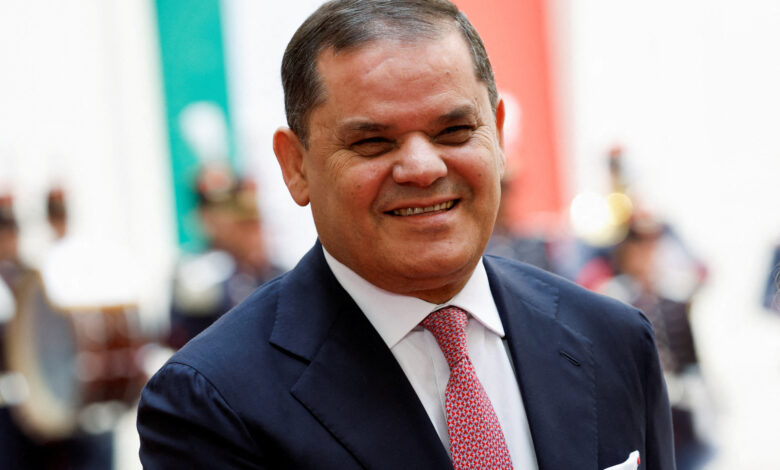
Libyan Prime Minister Abdulhamid Dbeibah has expressed his administration’s readiness to address Egypt’s concerns regarding maritime boundaries in the Mediterranean, marking a potential shift in the long-standing and complex dispute over economic waters in the region.
The prime minister of the UN-recognized Government of National Unity (GNU) conveyed the message directly to Egypt’s intelligence chief, Hassan Rashad, during a phone call on Saturday. According to the Prime Minister’s office, the discussion focused on bilateral relations and the coordination of matters of mutual interest, with a specific emphasis on the maritime and economic zones that have long been a source of regional tension.
This diplomatic outreach follows a significant development on Wednesday, when the Egyptian government officially rejected a maritime boundaries agreement recently ratified by Libya’s eastern-based parliament. That agreement, which also involved Turkey, was dismissed by Cairo as null and void. Egyptian officials stated at the time that the deal would have no legal effect on Egypt’s own claims or sovereign interests in the Mediterranean.
The friction over maritime territory in the Eastern Mediterranean is rooted in a 2019 agreement between the Tripoli-based government and Turkey. That initial accord was intended to define maritime boundaries and facilitate energy exploration, but it drew sharp criticism from neighboring states. Greece, Cyprus, and Egypt have consistently opposed the Libya-Turkey arrangements, arguing that the claims infringe upon their own established maritime zones and international maritime law.
Libya remains deeply divided between the Government of National Unity led by Dbeibah in Tripoli and a rival administration in the east, which is aligned with military commander Khalifa Haftar and the eastern-based parliament. While the eastern authorities had withheld approval of maritime deals involving Turkey for several years, their recent move to ratify an agreement prompted the latest pushback from Cairo.
Egypt and Libya share a sensitive land border and maintain deep-seated security and economic ties. The potential for large-scale energy exploration in the Mediterranean has raised the stakes for both nations, as they seek to clarify control over resource-rich waters. Dbeibah’s latest offer to engage directly with Cairo’s intelligence leadership suggests an attempt to find a bilateral path forward that might bypass the competing claims of the eastern administration.