A coalition of private citizens has filed a federal lawsuit against the administration of United States President Donald Trump, challenging ongoing restrictions placed on news organizations covering the White House. Filed in a federal court in New York, the legal action represents a distinct departure from previous challenges by targeting the administration from the perspective of individuals who consume and rely on independent journalism rather than the media outlets directly barred from the grounds.
The plaintiffs span a diverse range of professions, including a human rights advocate, a media watchdog, a university history professor, a high school teacher, a legal journalist, and a student journalist. According to the court filing, each individual depends on the White House press corps for independent reporting to support their daily work in scholarship, education, reporting, and advocacy.
“All of the Plaintiffs rely on the White House press corps for independent reporting about the president and his administration, and all of them use that reporting in a variety of ways in their scholarship, teaching, journalism, or advocacy,” the lawsuit states.
Participants in the legal action emphasize the practical consequences of restricted press access on public education and informed civic participation. Peter Schmidt-Nowara, a high school social studies teacher in New York City, voiced deep concern over the administration’s actions. “I’m gravely concerned that the Trump administration’s restrictions on White House reporters are cutting off access to crucial information,” Schmidt-Nowara said in a statement. “I joined this lawsuit because my students deserve to know what’s happening in their government and to hear from a free and independent press.”
The lawsuit adds to a growing list of legal disputes facing the Trump administration over its efforts to limit access for specific news outlets. Last month, the administration barred journalists from CNN, MS NOW, and from attending official White House news conferences. Although a federal judge subsequently ruled that the ban violated the First Amendment and ordered access restored, the administration has continued to contest that ruling in court.
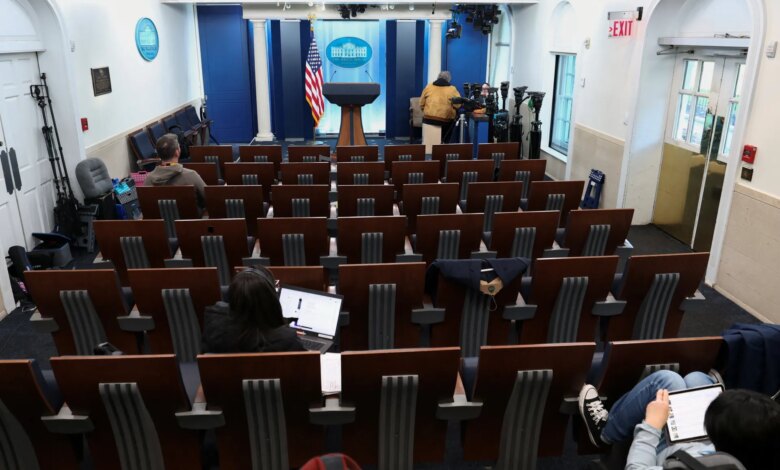
Beyond restrictions on specific outlets, questions have persisted regarding the physical workspace of the White House press corps. Last week, the president dismissed circulating reports that he intended to evict journalists entirely from the White House press briefing room to restore a swimming pool originally installed in 1933. However, he confirmed on social media that he remains open to relocating the press corps to an alternative location.
“I am thinking about moving the Press, and putting them in a different location, but I will use that location for very badly needed space,” Trump stated in the post.
Legal experts and human rights advocates observing the developments argue that limits on journalistic access carry broader implications for democratic institutions. Kenneth Roth, a senior fellow at Yale University and former executive director of Human Rights Watch, noted that restrictions on the press often parallel political shifts observed internationally. “Worldwide, I have seen how governmental leaders’ efforts to penalise independent journalists are a prelude to the rise of autocracy,” Roth said in a statement.