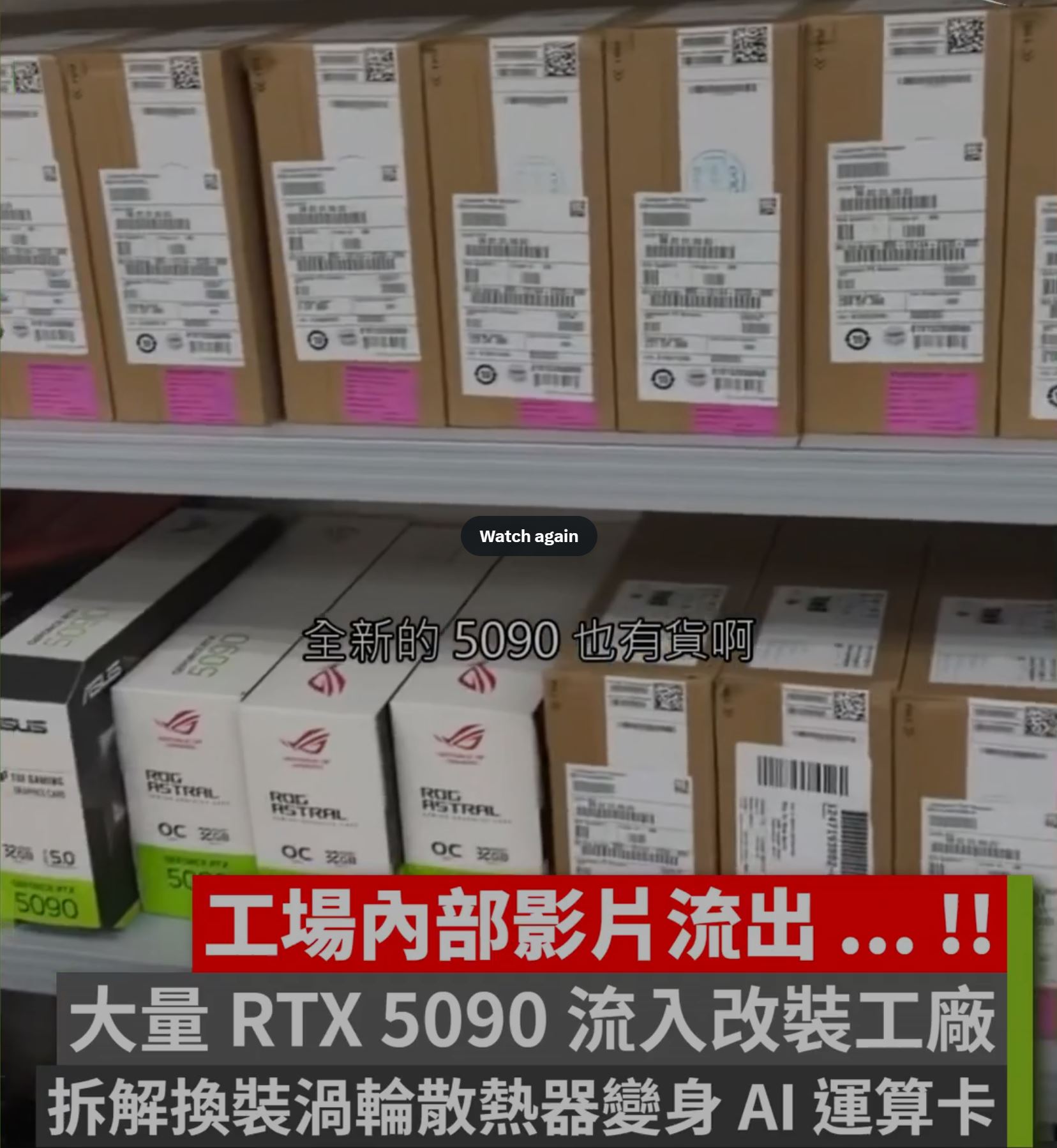
Recent video footage highlights a large-scale industrial operation in China where retail Nvidia RTX 5090 graphics cards are dismantled and rebuilt into specialized AI accelerators. The footage, originally shared by the Hong Kong hardware media outlet HKEPC, depicts a well-organized workshop floor stacked with consumer-grade hardware. Workers along a assembly line remove original triple-slot cooling assemblies and harvest the underlying graphic processing units and memory chips, transferring them onto custom-designed circuit boards.
The workshop operations involve retail hardware from major manufacturers including PNY, Gigabyte, Asus, and Nvidia’s own Founders Edition units. Unlike individual modifications performed on home workbenches, the footage reveals a systematic production workflow that includes post-modification testing to ensure functionality. The core motivation behind these labor-intensive teardowns stems from the physical constraints of data center environments. Standard consumer RTX 5090 cards feature bulky multi-fan coolers that occupy three or more expansion slots. While effective in desktop chassis, such dimensions prevent dense multi-GPU installation in standard server racks and disrupt internal airflow.
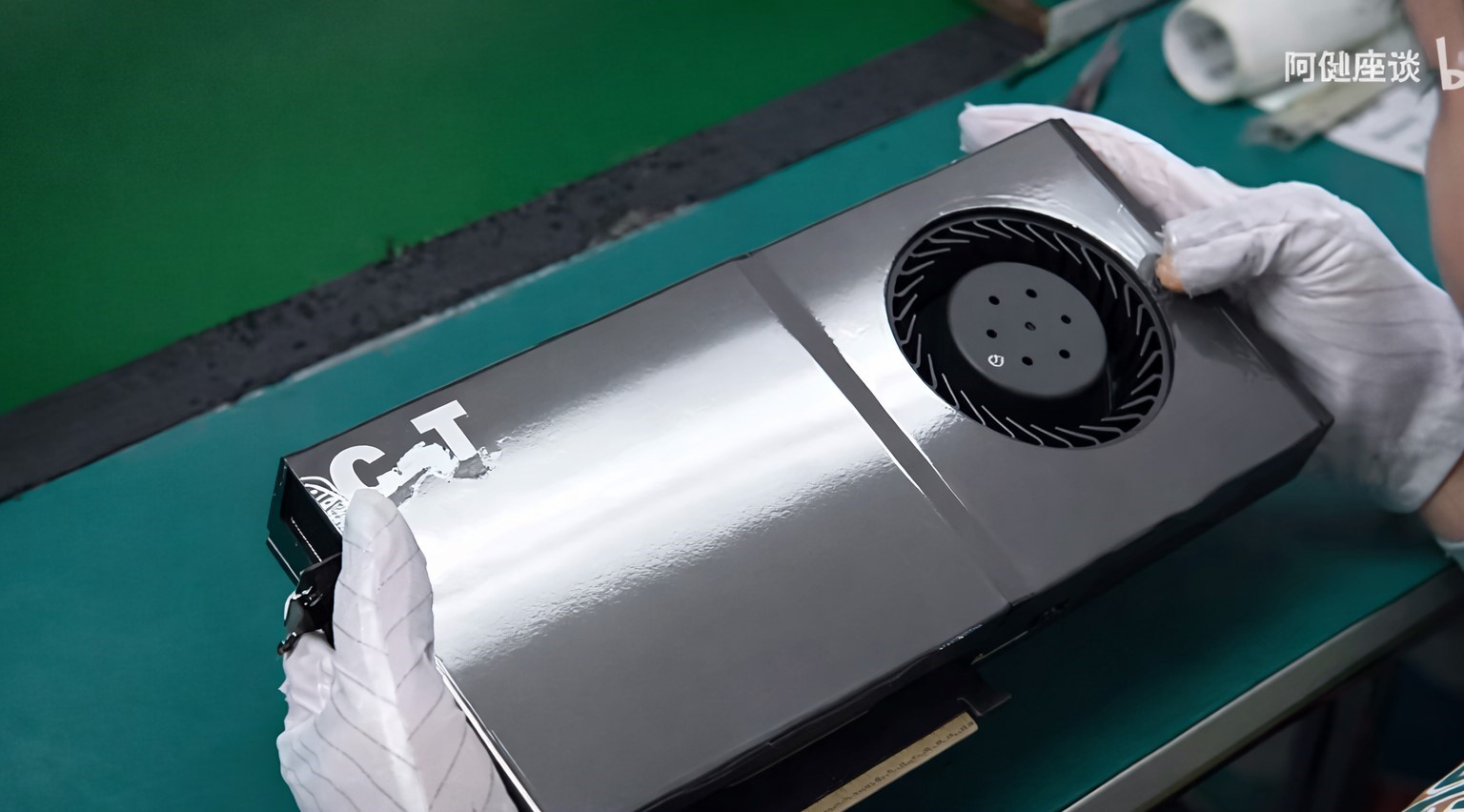
To overcome this limitation, conversion facilities mount the salvaged GB202 GPU cores and 32GB of GDDR7 memory onto newly engineered printed circuit boards. These custom boards employ a compact dual-slot form factor paired with centrifugal blower fans that exhaust heated air directly out of the server chassis. This redesign allows the hardware to fit into high-density server configurations designed for artificial intelligence workloads. The physical migration of the silicon requires sophisticated equipment capable of precision desoldering, surface cleaning, reballing, and precise resoldering, alongside custom power delivery layouts and interface positioning.
While rumors have circulated suggesting that Chinese modification shops can expand the RTX 5090 memory capacity to 64GB or 96GB, reliable public evidence supporting stable operation of such high-capacity variants remains absent. Current visual evidence indicates that the modified units retain their standard 32GB GDDR7 configuration. Despite the extensive circuit redesign, modified consumer hardware differs from purpose-built enterprise accelerators in critical categories such as long-term reliability guarantees, server management features, software support, and thermal redundancy.
The large-scale conversion efforts intersect with international export controls governing advanced computing silicon, drawing attention to how markets respond to restricted access to enterprise-grade data center processors. The high parallel computing performance of the Blackwell-architecture consumer flagship makes it an attractive alternative for enterprises and research teams unable to acquire specialized server GPUs through conventional channels. Nevertheless, the video footage alone does not establish procurement pathways, transaction legality, or direct violations of specific export regulations, as chip sourcing and modification practices represent distinct legal questions.
At the same time, the trend highlights ongoing supply tightness within the global gaming graphics card market. Nvidia executive Jeff Fisher stated in mid-October that the RTX 5090 remains in production and distribution continues, though supply chain constraints persist. While a shift of consumer inventory toward commercial AI computing infrastructure could theoretically intensify shortages for individual gamers and push market prices above official retail targets, available footage does not quantify the absolute output, total procurement scale, or precise market share of the conversion facilities. The phenomenon ultimately underscores the blurring boundaries between high-end gaming hardware and professional computing resources as global demand for artificial intelligence infrastructure accelerates.