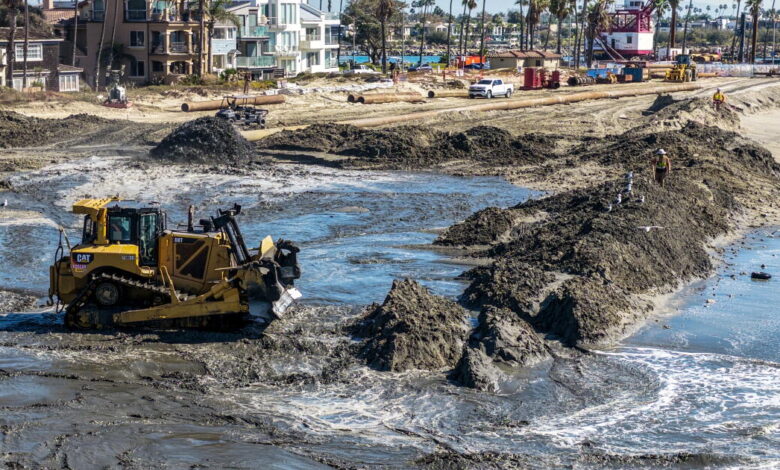
Monday morning brought a stark vision of the future to Southern California’s shoreline as sea levels in San Pedro reached an all-time record of 8.02 feet. This surge sent ocean water pouring into business districts and over arterial highways, marking what scientists describe as an unprecedented intersection of climate change, a powerful El Niño, and cyclical lunar patterns.
In Newport Beach, water from the harbor flooded the Balboa Fun Zone, forcing crews to pump out knee-high water while residents scrambled to reinforce sandbags. In Sunset Beach, the Pacific Coast Highway was inundated. This is no longer a distant threat; for communities from the Farallon Islands to Baja California, the ocean is physically expanding as it heats up, encroaching on infrastructure that was never built to withstand this new baseline.
The primary driver behind this week’s flooding is thermal expansion. Scientists note that hot water occupies more volume than cold water. Currently, the sea surface temperatures off the California coast are between 5 and 9 degrees Fahrenheit above seasonal averages. In La Jolla, the sea surface temperature at Scripps Pier hit 73.8 degrees on Monday—nearly 10 degrees higher than the 64.7-degree average for this time of year.
Climate scientist Daniel Swain, with UC Agricultural and Natural Resources, noted that the waters along the immediate coast are at record warm levels for this time of year. He explained that the thermal expansion being observed is comparable to, or even greater than, anything seen previously. This elevation of sea level is a cocktail of direct El Niño effects combined with the background warming of the ocean.

NASA climate scientist Josh Willis has dubbed the current phenomenon “El Niño Macho,” suggesting it may rival or surpass the catastrophic 1997 event that caused trillions of dollars in global damage. However, the stakes are higher now. Over the last 125 years, sea levels off the California coast have risen by about one foot, with significant progress in that rise occurring just in the 20 years since the last major El Niño. This provides a higher platform for modern surges to build upon.
Specific records are falling. The 8.02-foot measurement at Los Angeles Harbor in San Pedro surpassed the previous record of 7.93 feet set on January 10, 2005. David Gomberg, a meteorologist with the National Weather Service in Oxnard, noted that the actual water level was 1.42 feet higher than what astronomical tides alone would have produced. This discrepancy is attributed to a combination of warm-water expansion and the arrival of Kelvin waves—subsurface movements of warm water that travel across the Pacific at roughly 6 mph.

In Long Beach, the pressure is mounting on aging infrastructure. Residents in the Naples and Peninsula neighborhoods reported water leaking through the base of seawalls. Nancy Pinckert, a Naples resident, expressed concern that the city’s defenses are under profound stress. She noted that while Monday’s flooding was severe, the upcoming king tides in November and December could cause the first-ever breach of the walls.
The timing of this onslaught is particularly precarious because of the moon. According to Reinhard Flick, a researcher at the Scripps Institution of Oceanography, the Earth is currently near the peaks of the 18.6-year lunar node and 4.4-year lunar perigee cycles. These orbital shifts amplify tide-generating forces. When these high-tide cycles coincide with a strong storm—as occurred during the destructive winter of 1983—the potential for pier and property damage increases exponentially.
While the current flooding has already disrupted daily life, experts warn that the worst may be yet to come. Mark Merrifield, director of the Center for Climate Change Impacts and Adaptation at UC San Diego, previously warned that this season would likely see the highest sea levels ever recorded on the California coast. If a major storm hits during the high-tide windows expected around Thanksgiving, Christmas, or Martin Luther King Jr. Day, the consequences could be severe.
The signs of this volatile season appeared as early as Labor Day weekend. Remnants of former Hurricane Marie sent swells that flooded homes on the Long Beach Peninsula and along Beach Road in Dana Point. In Malibu, the surge caused a sinkhole to open in the driveway of actor Nicolas Cage’s home, forcing evacuation orders for dozens of nearby residents.
Beyond the property damage, the ecological toll is significant. Scientists emphasize that such dramatic temperature deviations are bad for the local ecology, threatening plankton and the bird populations that depend on them. While sports fishermen may find unusual warm-water species moving north, the long-term persistence of these record temperatures suggests a fundamental shift in the Pacific coastal environment that infrastructure and nature alike are struggling to accommodate.