The European Commission has intervened in Poland’s escalating political and institutional crisis, calling on President Karol Nawrocki to validate the appointment of eight new judges to the country’s Constitutional Tribunal. The executive body of the European Union threw its support behind Prime Minister Donald Tusk on Saturday, emphasizing that national authorities must ensure the tribunal functions in compliance with both the Polish Constitution and relevant European Court of Justice jurisprudence.
“The nomination of eight new members of the Constitutional Tribunal falls within the constitutional competence” of the Sejm, the lower house of the Polish parliament, a European Commission spokesperson told journalists on Saturday evening. President Nawrocki has thus far refused to endorse those legislative appointments, blocking efforts by Tusk’s centrist coalition to resolve a long-running standoff over the composition and independence of the court.

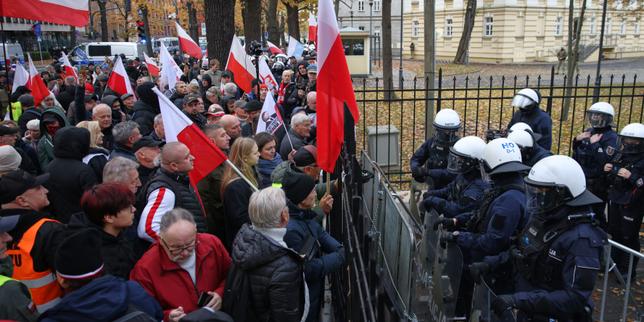
Tensions reached a boiling point late last week in a rapid acceleration of events that saw riot police secure the perimeter of the tribunal building in Warsaw to block access. Simultaneously, the justice minister, who also serves as prosecutor general, moved to lift the immunity of the tribunal’s current president, Bogdan Swieczkowski, an appointee of the former nationalist Law and Justice (PiS) administration. Amid the overnight turmoil, Anna Korwin-Piotrowska, a newly appointed judge backed by the current parliamentary majority, announced she was assuming interim leadership of the court.
The leadership dispute within the tribunal remained deadlocked on Saturday. While Korwin-Piotrowska declared Swieczkowski suspended from his duties, Swieczkowski maintained that he remained in office, backed by the opposition and the president. The Helsinki Foundation for Human Rights, a prominent regional watchdog organization, questioned the legal basis for the tribunal president’s suspension but nevertheless urged President Nawrocki to ratify the Sejm’s judicial picks while calling for broader structural reforms to insulate the court from partisan capture.

Earlier on Saturday, President Nawrocki held consultations with representatives from both the centrist governing majority and nationalist opposition parties in an effort to defuse the crisis, though the talks yielded no tangible breakthroughs. The confrontation intensified dramatically after police secured the tribunal site while Nawrocki was airborne en route to an official visit to Senegal. The president immediately aborted the trip, returned to Poland, and entered the tribunal building late Saturday evening despite resistance from certain magistrates.
The extraordinary intervention drew sharp rebukes from both sides of Poland’s deeply polarized political landscape. Prime Minister Tusk took to social media on Saturday evening to defend the government’s posture, accusing unnamed political actors of attempting to dismantle democratic norms and the rule of law. “In a democratic state, a political leader cannot enter a tribunal to give orders or intimidate judges, even if he is president,” Tusk remarked later, criticizing the president’s abrupt return and forced entry into the courthouse.

Meanwhile, conservative activists and PiS sympathizers have maintained a steady presence outside the tribunal in recent weeks to protest the government’s actions. Iwona Dudek, a 62-year-old demonstrator who traveled from Zgorzelec near the German border, argued that the prime minister’s maneuvers had inadvertently galvanized a fractured political right. Opposition lawmakers rallied outside the courthouse following Friday’s police deployment.
Analysts warn that the turbulence is being severely exacerbated by the approach of the November 2027 parliamentary elections. Ewa Marciniak, a political scientist at the University of Warsaw, noted that the country has effectively entered an active campaign phase characterized by intense base mobilization and a high risk of continued escalation.

The Constitutional Tribunal has remained a central flashpoint between Warsaw and Brussels since the PiS government appointed politically aligned judges to the bench between 2015 and 2023—appointments that neither the EU nor Tusk’s current administration recognize as legitimate. With no clear mechanism agreed upon by rival branches of government to resolve the deadlock, the operations of Poland’s highest constitutional arbiter remain mired in institutional confusion.