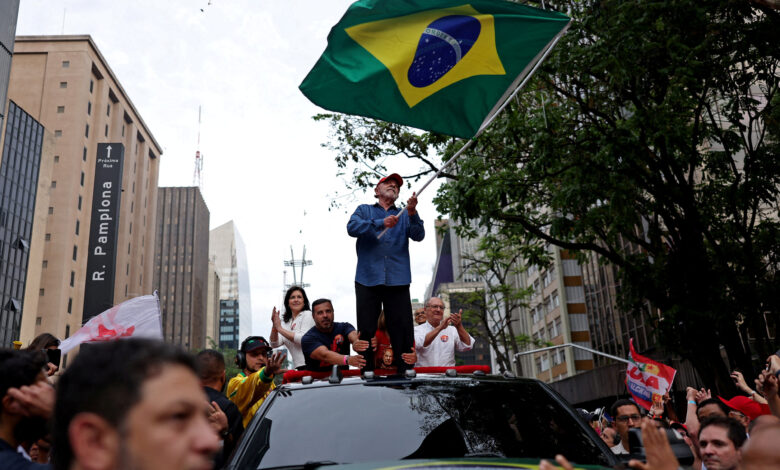
Brazilians head to the polls on Sunday in a presidential runoff that carries the potential to shift Latin America’s largest nation sharply toward the right, deepening a conservative trend across the region and potentially aligning Brasilia more closely with the United States. The election is a high-stakes confrontation between incumbent leftist President Luiz Inácio Lula da Silva and right-wing Senator Flavio Bolsonaro, the 45-year-old son of former President Jair Bolsonaro.
The race follows a significant political upset earlier this month when Flavio Bolsonaro defied polling expectations to lead the first round of voting. While polls now suggest the candidates are in a statistical dead heat, historical precedent weighs in favor of the challenger; no Brazilian presidential candidate has ever successfully claimed the office after finishing second in the first round. In that initial vote, Bolsonaro secured 47% of the ballots, while Lula trailed with 45%.
The shadow of former President Jair Bolsonaro looms large over the contest. The elder Bolsonaro was convicted in 2025 for his role in plotting a 2022 coup, a legal case that his son has promised to resolve if elected. Flavio has publicly pledged to free his father if he wins the presidency, a move that would likely ignite further domestic polarization. The legal battle has also become an international flashpoint, as U.S. President Donald Trump has characterized the case against the elder Bolsonaro as a “witch hunt.”
Diplomatic and economic relations with Washington have been a central theme of the campaign. Under the Trump administration, the U.S. has maintained a complex and often adversarial relationship with Lula’s government, clashing over matters of security and trade. In 2025, the U.S. imposed a 50% tariff on Brazil in a move explicitly connected to the trial of Jair Bolsonaro. Although some of those measures were later moderated, new levies were introduced this year over allegations of unfair trade practices. Lula has denounced these measures as “bullying” and accused the U.S. of attempting to influence the election through its proximity to the Bolsonaro family.
On the domestic front, the campaign has been defined by a mix of economic anxiety and public safety concerns. Despite official data showing falling inequality and unemployment under his administration, Lula has struggled to convince a skeptical electorate currently burdened by high living costs and significant household debt. These economic pressures, combined with concerns over endemic gang violence, have created an opening for Bolsonaro’s law-and-order platform.
Bolsonaro has campaigned on a promise to implement a heavy-handed approach to criminal justice, including the construction of maximum-security jails and the introduction of chemical castration for serious sexual offenses. His pro-business rhetoric and first-round success have already found favor with financial markets, which saw Brazil’s currency and stock market rise following the initial vote. Furthermore, the Liberal Party and other right-wing factions saw significant gains in recent congressional elections, suggesting that even if Lula secures a fourth mandate, he will face a formidable legislative opposition that could complicate his ability to govern.
As voters cast their ballots, the outcome remains too close to call. While Lula has managed to close the polling gap in the final days of the campaign, the momentum from the first round and the shifting ideological landscape of Latin America suggest a highly unpredictable finish to one of the most consequential elections in Brazil’s modern history.