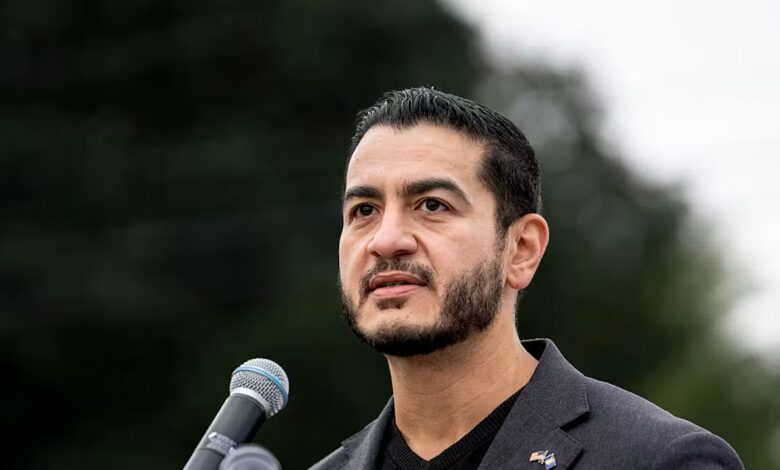
A faction of Arab American voters in Michigan who helped deliver the state to Donald Trump during the 2024 presidential election are expressing deep disillusionment with the Republican Party, with some now throwing their support behind Democrat Abdul El-Sayed. These voters argue that the current administration has failed to follow through on core “America First” promises, pointing specifically to ongoing foreign conflicts and domestic economic pressures as reasons for their defection.
The shifting political alignment could significantly complicate Republican candidate Mike Rogers’ strategy to preserve and build upon the substantial gains Trump made among Arab American voters. A recent Washington Post-Schar School poll of registered Arab American voters nationwide, conducted between August and September, indicated that 58% favor Democrats for Congress compared to 34% who prefer Republicans. In Michigan, where nearly 400,000 residents are of Arab ancestry, the demographic holds considerable electoral weight.
Despite the friction, loyalty among Arab American Trump voters is not entirely shattered. Two-thirds of the community still express approval of Trump’s overall performance, even as 54% disapprove of his handling of Israel’s war in Gaza, according to the same polling data. In Dearborn, a majority-Arab American city that Trump carried by six points in 2024, voters like 62-year-old Yemeni American Walid Fidama voiced frustration over the persistence of overseas hostilities.
“I don’t see peace anywhere. He made it worse. We have started a war. For why?” Fidama told reporters, pointing to continued foreign conflict and rising household expenses. Fidama noted that he was initially drawn to El-Sayed, a former public health official and son of Egyptian immigrants, because of his economic platform, which features Medicare for All and a pledge to eliminate dark money from politics.
Other former Trump supporters echoed these sentiments, expressing betrayal over continued U.S. financial and military support for Israel, which they argue directly contradicts promises to keep American resources out of overseas entanglements. Mustapha El-Jaroudi, a 27-year-old two-time Trump voter, said his understanding of “America First” meant keeping taxpayer dollars at home. He criticized Rogers as a staunch supporter of Israel who would prioritize foreign interests over American ones.
“I might not agree with everything El-Sayed says, but at least he’s not being bribed,” El-Jaroudi said, referencing El-Sayed’s outspoken criticism of politicians who accept campaign support from the pro-Israel lobbying group AIPAC.
Hassan Nehme, a former Michigan Republican Party vice chair who spearheaded outreach to Arab American voters during the 2024 election cycle, acknowledged that the party has lost significant ground since the administration took office. Once the administration entered the White House, Nehme said, previous commitments seemed to flip-flop, leaving Republicans “dead in the water in the area right now.”
At the same time, the contest has grown increasingly contentious. Arab American leaders have publicly criticized Trump for labeling El-Sayed a “jihadist.” Meanwhile, Rogers’ campaign has intensified scrutiny of El-Sayed, challenging him over appearances with left-wing streamer Hasan Piker and his initial reaction to a March attack on Temple Israel in West Bloomfield Township.
Following the synagogue attack, El-Sayed condemned the violence but also remarked that “hurt people hurt people” and that “violence is a cycle.” He later issued an apology for those remarks and has repeatedly condemned antisemitism. Rogers’ campaign spokeswoman, Alyssa Brouillet, asserted that the campaign welcomes all Michiganders regardless of background while accusing El-Sayed of fueling antisemitism and sympathizing with the attacker.
El-Sayed’s campaign has fired back, asserting that Rogers is relying on personal attacks to deflect attention from his legislative record and reliance on corporate donors. A Detroit News/WDIV-TV survey conducted between October 19 and 22 showed El-Sayed leading Rogers 51.4% to 45.1% among likely voters in the state.