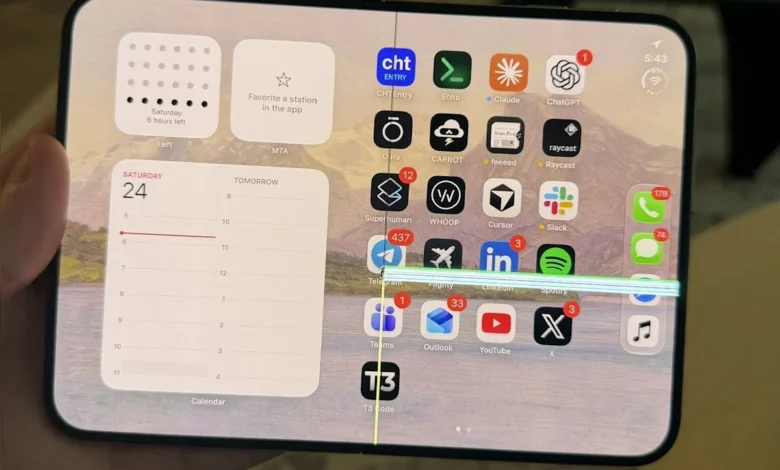
Just days after its high-profile debut, Apple’s first venture into the foldable smartphone market is facing significant hardware concerns. A growing number of early adopters of the iPhone Duo have reported that the device’s expansive inner display is cracking or malfunctioning within hours or days of initial use, often accompanied by an audible crunching sound during operation.
The iPhone Duo represents the most substantial design overhaul in the history of Apple’s flagship product line and comes with a premium starting price of $1,999. While the company spent more than a decade developing the technology to compete in the foldable space, the early reports suggest a recurring failure centered on the device’s internal hinge and crease area.
Multiple customers have described a specific sequence of failure. Users report hearing a loud noise when unfolding the device, followed by the immediate appearance of a large crack running vertically along the center crease. In several instances, the hardware failure resulted in a white patch or “bleeding” pixels on the right side of the inner screen, rendering the primary display unusable. Some users noted that even when the inner screen failed, the device’s smaller outer display continued to function, though the phone often registered phantom touches on the damaged internal panel.
Tom Battle, a customer in San Diego, described the experience of opening his new device only to find it felt unusually resistant. After unfolding it, he discovered lines across the screen and felt a physical bump or loose component beneath the display surface. Similarly, venture capitalist Jonathan King reported hearing a crunch-like sound on a Monday after intending to post a positive review of the product. He noted that the failure rendered the inner screen entirely unusable.
Repair specialists at iFixit, who perform detailed teardowns of consumer electronics, have suggested that the root cause may not be the flexible display panel itself, but rather a mechanical failure within the hinge. The group believes a failing hinge component may be pressing upward, physically cracking the screen from the inside out. This theory aligns with reports from several users who felt an unusual protrusion or “bump” near the crease before or during the failure.
Apple has officially acknowledged the situation, stating it is aware of an issue impacting the inner display on what it describes as a “small number” of iPhone Duo units. The company has advised affected customers to contact AppleCare for a replacement. Apple maintained that most units are not affected and that the defect typically manifests very quickly in impacted devices.
However, the replacement process has proven difficult for some. In Richmond, Virginia, a customer identified as Centrino31A was told by retail employees that the issue was a manufacturing defect, but the store had no Genius Bar appointments available and no replacement inventory in stock. Another user, Surya Mangi of Allen, Texas, was informed he might be without a phone for over a week if he sent the device in for repair, though Apple eventually agreed to ship a replacement via express mail.
In Chennai, India, user Vishnu Rajkumar experienced a similar failure while setting up apps. He reported that the screen began “bleeding” after he encountered unusual tightness while opening the device. Unlike some U.S. customers, Rajkumar was able to secure a replacement through an authorized reseller, noting that his second unit has functioned without issue for its first 24 hours.
Internal reports suggest that while a dedicated engineering team is investigating the failures—even performing “Early Field Failure Analysis” on units returned to flagship locations like the Fifth Avenue store in New York—official guidance has not yet been distributed to all retail staff. In some cases, store employees expressed surprise at the defect, as they were seeing the issue for the first time.
The reports are particularly notable given the public stance Apple executives have previously taken regarding foldable technology. Chief Executive Officer John Ternus had formerly criticized rival Android-based foldables as “cheap,” while hardware engineering head Tom Marieb encouraged the public to hold the company accountable for the durability of the Duo’s display crease.
Apple has successfully navigated early hardware controversies in the past, including the iPhone 4 “Antennagate” in 2010 and the iPhone 6 Plus “Bendgate” in 2014. Whether the current display issues represent a localized manufacturing batch error or a broader design flaw in the $1,999 device remains under investigation by the company’s engineering teams.