U.S. Soccer is deliberately channeling the momentum of a successful home World Cup cycle into a long-term strategy centered on the 2028 Los Angeles Olympics. Following a tournament that shattered viewership records and generated millions of new supporters, federation leadership views the upcoming stateside Summer Games as a generational opportunity to elevate both the men’s and women’s national programs.
Federation Chief Operating Officer Dan Helfrich and CEO JT Batson have overseen critical structural decisions, including securing manager Mauricio Pochettino on a four-year contract following the senior team’s run to the round of 16 in the 2026 FIFA World Cup. Furthermore, the federation recruited three-time former U.S. World Cup defender and MLS Cup-winning LAFC coach Steve Cherundolo to lead the American men at the LA28 Games.
While the senior men’s team demonstrated competitiveness during the World Cup, federation officials recognize that global powerhouses such as Spain, Argentina, and France remain a tier apart. The Olympics, however, present a different competitive landscape. Primarily an under-23 tournament permitting three overage players per squad, the Olympic format offers mid-major national programs a realistic path to the podium. Mexico famously secured the gold medal in London in 2012, and U.S. leadership believes a similar breakthrough is achievable on home soil.
The ambition for LA28 includes a potential 12-nation men’s tournament where advancing from group play leaves teams just one knockout-stage win away from the medal rounds. Federation planners envision packed crowds at the historic Rose Bowl for the final weekend of July 2028, creating an atmosphere capable of further cementing soccer’s cultural footprint in the United States.
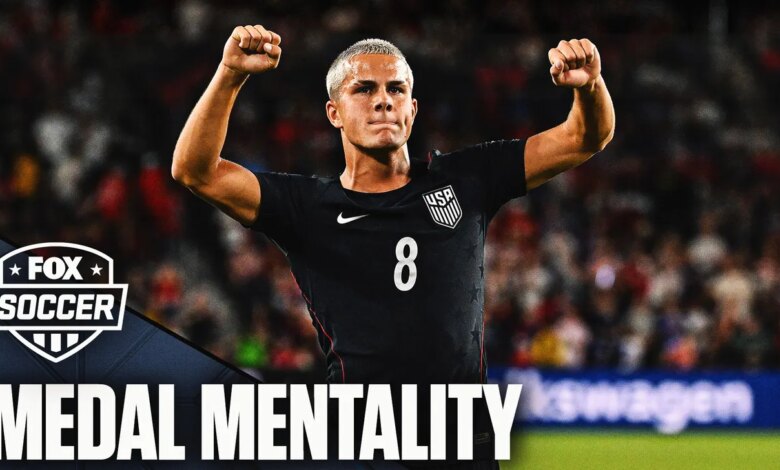
A wave of blue-chip teenagers has already begun fueling optimism within the program. Almost half of Pochettino’s recent roster selections consist of players age-eligible for the LA Games. Standouts include 18-year-old Julian Hall, who scored in his first three senior international appearances—including the winner in a 3-0 exhibition victory over Mexico—and 17-year-old Cavan Sullivan, who established himself as the youngest goalscorer in program history during the same fixture. Other prominent under-23 candidates featured in recent camps include forward Justin Ellis, 6-foot-7 center back Neil Pierre, and goalkeeper Diego Kochen.
As preparations continue, Cherundolo will eventually assume primary leadership of the Olympic squad, a priority expected to persist even if Pochettino’s senior side simultaneously navigates a potential U.S.-hosted 2028 Copa América. A key operational hurdle for Cherundolo will involve securing the release of players from European clubs, as FIFA does not mandate club release for Olympic youth tournaments in the same manner as senior global fixtures. However, domestic MLS clubs have historically supported youth call-ups, a trend expected to hold steady given the domestic spotlight and transfer market incentives generated by a home Olympics.
Federation planning also accounts for the historical correlation between strong Olympic performances and subsequent World Cup success. Analysis of recent tournament rosters reveals that numerous players from Spain’s 2026 World Cup-winning squad, as well as finalists Argentina and France, previously competed in the Olympics. U.S. Soccer experienced a similar trajectory following the Sydney 2000 Games, where a fourth-place Olympic finish preceded the senior team’s historic run to the quarterfinals at the 2002 World Cup.
With a full four-year cycle ahead rather than the compressed timelines that preceded previous major tournaments, federation officials emphasize that this upcoming phase operates under a distinct set of goals. By connecting the 2026 World Cup, the 2028 Olympics, and a prospective 2031 Women’s World Cup on home soil, U.S. Soccer aims to establish a continuous pipeline of competitive talent.