
Long-term participants in the United Kingdom’s buy-to-let property market are increasingly liquidating their real estate holdings, driven by a cumulative series of tax increases and regulatory shifts implemented by successive administrations.
Dan Pilley, a 55-year-old investor who began purchasing rental properties in 2004, once held 18 homes in and around Haverhill, a town roughly 50 miles northeast of London. Following years of policy changes from both Conservative and Labour governments that reduced returns, Pilley has reduced his holdings to three properties. He has redirected capital toward commercial property contracts, which carry reduced maintenance responsibilities.

“It just starts to be an investment that you look at and think, ‘Do you know what? I can do a lot better with my money elsewhere for a lot less hassle,'” Pilley said.
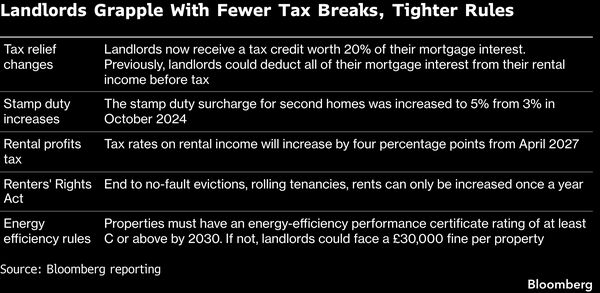
The downward pressure on rental portfolios intensified following Wednesday’s budget, in which UK Chancellor John Healey announced a 4 percentage point increase in property income tax set to take effect in April 2027. Depending on an individual’s tax bracket, the adjustment will elevate rates to 24%, 44%, or 49%. This policy supersedes a previously planned 2 percentage point increase outlined by Healey’s predecessor, Rachel Reeves, during the previous year’s budget.

Over the past decade, successive governments have systematically curtailed tax relief on mortgage interest, increased stamp duty on second homes, established limits on rent increases, and introduced stricter regulations governing rental housing. James Brand, a 53-year-old former investment banker who began investing in rental properties during the 1990s, built a portfolio of 14 houses across London and the Southeast with approximately £4 million in debt by 2003. Following property relief modifications introduced by the Conservative government in 2015, Brand began selling properties to pay down mortgages and currently maintains six rental houses.
“I’m looking at it and I’m thinking I would do better — which I am in some places — just sticking my money in ISAs,” Brand said, describing the sector as largely no longer economically viable.
While early real estate investors recorded substantial gains — estate agent Hamptons estimates an average total return of 2,130% since 1996 — broader market dynamics have shifted. Over the past five years, equity performance has outpaced residential property, with the S&P 500 exceeding buy-to-let returns of 41%.
Simon Gammon, managing partner at mortgage broker Knight Frank Finance, noted that successive governments have viewed second-home and buy-to-let ownership as politically vulnerable targets. He added that purchasing most rental properties no longer makes financial sense unless an investor secures an unusually high yield or finances a minimal portion of the purchase price with debt.
As landlords exit the market, the shrinking supply of available rental housing has coincided with rising costs for tenants. Data released by SpareRoom indicated that the supply of rooms available for flatshares across the UK fell by nearly 5% over the past year, while rental prices reached record highs in seven of the country’s nine regions.
Jeremy Leaf, a London estate agent, stated that the budget contained no provisions to encourage new landlords to enter the sector or persuade existing investors to remain. Financial advisors suggest alternative avenues for capital deployment, including individual savings accounts (ISAs), pensions, and short-dated gilts, which offer specific tax advantages for higher-rate and additional-rate taxpayers.