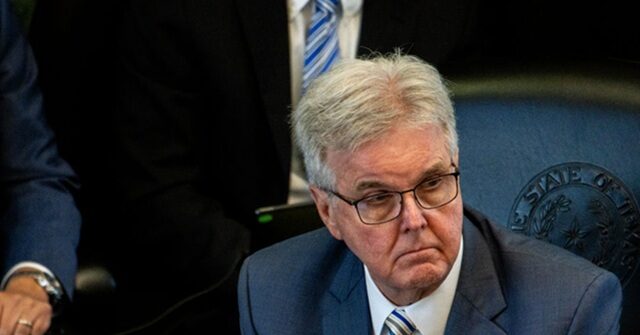
Texas Lieutenant Governor Dan Patrick expressed confidence this week that a late surge of Republican voters will soon eclipse early Democratic leads in the Lone Star State. As the midterm election cycle intensifies, Patrick indicated that while early returns may show an initial advantage for the opposition, his internal metrics suggest a massive block of reliable conservative voters has yet to arrive at the polls.
During a recent discussion regarding the state of the race, Patrick estimated that approximately 600,000 “high-propensity” Republican voters have not yet participated in early voting. He predicted that the Republican Party would likely catch up and surpass Democratic totals by the middle of next week, securing what he described as a healthy lead by the conclusion of the early voting period. Patrick, who is facing a challenge from Democratic State Representative Vikki Goodwin, has spent recent days urging his base to move quickly to the ballot box.
The Lieutenant Governor framed the high-stakes election as a choice between two fundamentally different visions for the state. He argued that the modern Democratic platform has shifted significantly over the last decade, positioning his own party as the defender of traditional Texas values, including low taxes, pro-business policies, and border security. Patrick specifically highlighted a commitment to law enforcement, contrasting Republican support for police with Democratic policies on bail reform in major urban centers.
This push for voter mobilization comes amid a significant spike in participation across Texas. Analytical data on the current election cycle shows that early voting in the state has increased by 74% compared to the 2022 midterm elections. The surge is not isolated to Texas; several other states critical to determining control of the U.S. Senate have seen similar jumps. Early in-person and mail-in voting has more than doubled in Kansas and increased by more than 30% in Maine, North Carolina, and Ohio compared to the same point in the previous midterm cycle.
Federal leadership has echoed the optimism seen at the state level. House Speaker Mike Johnson recently visited Texas for a series of campaign events, where he dismissed current polling that suggests a tighter race or Democratic advantages. Johnson claimed that the energy he has observed on the ground in swing districts is not being accurately captured by traditional surveys. He noted that the atmosphere at recent rallies across several states feels more akin to a presidential election year, suggesting that Republican enthusiasm may lead to results that surprise pollsters.
As the final days of early voting approach, Patrick has directed a specific appeal to rural Republican voters, whom he views as the key to maintaining the party’s dominance in state government. The focus remains on ensuring that the 600,000 identified high-propensity voters translate their intent into confirmed ballots before the window for early participation closes.