When Altayeb Alhadi was just six years old, his father died after a well collapsed in his village in White Nile state, south-central Sudan. Two months later, his mother also passed away, leaving five siblings orphaned. As the eldest brother, Altayeb bore the responsibility of finding work to help his family survive.
At 14, he travelled hundreds of kilometres from his home in Galli village to seek work in northern Sudan, where gold mines dot the landscape, aiming to feed his siblings and keep them in school. His uncle, Alhadi Hamid, recalled the family’s concerns. “We warned him about the dangers, but he was ambitious,” Hamid said, noting that some relatives were already working in the area in service jobs rather than underground extraction.
Altayeb initially worked in transport before joining young men and children searching for gold in the surrounding mountains near Jabal Al-Aigdat in the Red Sea region. Working night and day with basic tools, the group extracted material from rocks to take to nearby mills for processing. Proceeds were shared based on individual agreements and the amount recovered. On productive days, the group could earn more than $100, though workers often dug for two to three weeks to find a gram or less.
On October 10, Altayeb died in an air strike attributed to the Egyptian military at the mining site near Jabal Al-Aigdat, an attack that killed at least 72 miners. A fellow miner, speaking anonymously, described the chaotic scene. “It was less than 30 minutes since we separated, and he said he was going to the mine. We suddenly heard a loud sound of bombardment, and we ran,” the colleague said. Miners found Altayeb with severe injuries and tried to help him, but he died within hours.

Ten days before his death, Altayeb told his siblings he would soon return home. Friends reported seeing him at a restaurant near the site on the morning of the attack, where he shared a tea before heading to the mine for the final time.
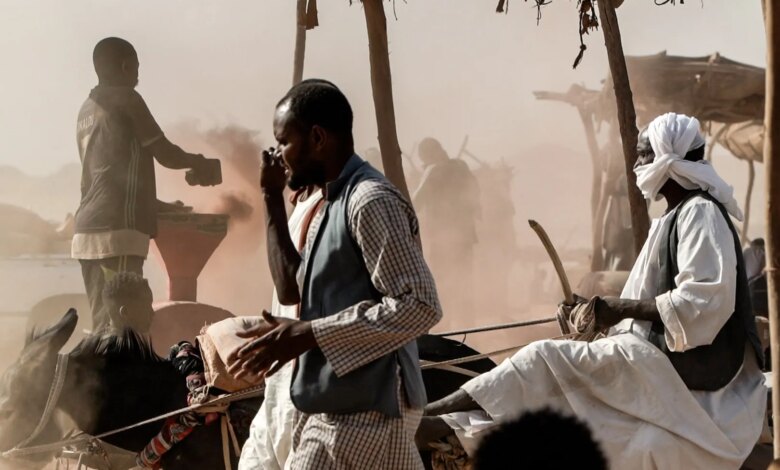
The broader economic crisis in Sudan, exacerbated by the civil war between the military and the Rapid Support Forces paramilitary group that broke out in 2023, has tanked the economy and forced thousands without other income into artisanal gold mining. Operations range from independent prospecting to working in investor-owned pits for a share of proceeds. Workers face harsh conditions, often sheltering in makeshift huts made from burlap sacks and plastic sheeting while subsisting mainly on lentils and sorghum porridge.

Egyptian authorities have accused Sudanese miners of crossing the border and linked some to gold smuggling, drugs, and human trafficking, though the Sudanese side did not respond to these allegations. Egypt claimed prospectors mined near a concession managed by an Egyptian company, but independent evidence remains scarce. Local sources and miners also reported that several people were killed and injured in attacks on mining sites near the Egyptian border on June 16.
In response to the violence, Sudanese military leader Abdel Fattah al-Burhan reportedly ordered a fact-finding committee comprising prosecutors, judicial representatives, and security agencies to investigate the attack. However, findings from an inquiry into a similar incident announced in June have not been made public.
Artisanal and small-scale mining accounted for 53.71 tonnes, representing about 83 percent of Sudan’s declared gold production in 2024 in government-controlled areas, according to Chatham House research. About one million people were involved in artisanal mining across Sudan’s 18 states, generating $1bn annually.
Following Altayeb’s death, his siblings are now living with extended family members in Galli village, where community initiatives are underway to support them and preserve his memory.