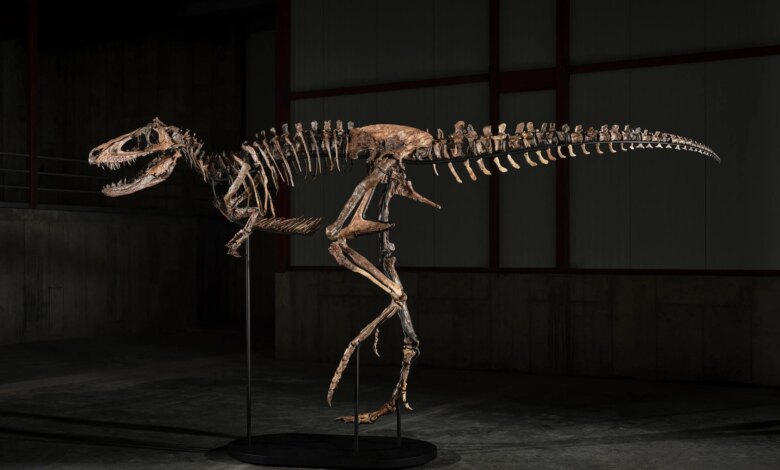
A rare Nanotyrannus specimen known as “Jodi” sold at Sotheby’s on October 27 for $47.3 million following a competitive 12-minute bidding battle among six prospective buyers, culminating in a winning bid placed over the phone. The high-profile sale establishes Jodi as the second-most-valuable dinosaur ever sold at auction, trailing only the Tyrannosaurus rex “Gus,” which fetched $50.13 million at Sotheby’s in July. That previous summer sale surpassed the $44.6 million paid for the Stegosaurus “Apex” in 2024 by billionaire Ken Griffin.
The mounted skeleton stands approximately 9 feet 6 inches tall on its armature and measures 19.6 feet from nose to tail, featuring a virtually complete skull comprising 53 bones. Dating to the Maastrichtian stage of the Late Cretaceous approximately 67 million years ago, the specimen is sufficiently developed that experts have concluded it belonged to an adult. The freestanding mount incorporates 3D-printed and sculpted restoration elements to help viewers visualize the animal’s appearance in life. Jodi was discovered in 2019 by Jodi Pierson on her privately owned land within the Hell Creek Formation in Garfield County, Montana, near the town of Jordan. It was subsequently acquired by its consignor in 2021 and exhibited by antiquities and fossil dealer David Aaron at Frieze Masters in 2023 under the name “Chomper” with a $20 million asking price, having been misidentified at the time as a juvenile T. rex.
The transaction highlights the continued expansion of the commercial fossil market, which is supported by U.S. legal frameworks allowing fossils discovered on private land to be bought and sold commercially subject to ownership rights. While commercial advocates argue that private excavations recover specimens that might otherwise erode or remain undiscovered, critics caution that high-value sales risk removing scientifically vital specimens from public access and research channels. The market has also intersected with broader luxury asset enforcement; in November 2025, Chinese businessman Su Binghai surrendered a pair of Allosaurus skeletons and a Stegosaurus acquired in a December 2024 Christie’s London sale as part of an asset recovery settlement linked to a major money-laundering investigation in Singapore.
Despite such controversies, private acquisitions do not universally exclude public access or scientific study. Ken Griffin, a prominent collector in the category, arranged a four-year loan of Apex to the American Museum of Natural History in New York following its 2024 purchase, allowing researchers to study the fossil while funding educational initiatives and a permanent cast through his philanthropic foundation. Prehistoric specimens have likewise made inroads into traditional art spaces. In 2025, Phillips included “Cera,” a complete juvenile Triceratops, in a contemporary art evening sale where it brought in $5.4 million against a $2.5 million low estimate. Online platforms have also drawn new buyers, as demonstrated by the online-only sale of “Trey,” a Triceratops unearthed near Lusk, Wyoming, in 1993, which fetched $5.5 million through Pharrell Williams’s platform Joopiter after nearly three decades on display at the Wyoming Dinosaur Center.

The broader auction market has experienced a decades-long upward trajectory, climbing from $8.36 million paid for “Sue” at Sotheby’s in 1997 and $31.85 million for “Stan” at Christie’s in 2020 to the record-breaking figures set in recent years. A peer-reviewed study published in Geoheritage in 2025 analyzed 10,471 fossil auction listings across 115 auction houses between 2010 and 2022, documenting €102.36 million in cumulative sales. The research noted that while dinosaurs accounted for a fraction of traded specimens, they generated the highest financial returns as annual offerings rose significantly over the study period.