In the modern streaming landscape, the first five minutes of a series often determine whether a viewer stays for the next five hours. Prime Video has increasingly focused on this engagement window, populating its catalog with action thrillers that trade slow-burn introductions for immediate narrative impact. These series—ranging from espionage dramas like The Night Manager to gritty adaptations like Reacher—utilize the ‘cold open’ not just for an adrenaline rush, but to establish the core danger and emotional stakes of the entire season.
One of the most recent examples of this strategy is the 2025 series The Assassin. Starring Keeley Hawes, the show centers on Julie, a retired hit-woman whose quiet life on a Greek island is interrupted by her estranged son, Edward, played by Freddie Highmore. However, before the audience meets the older Julie, the series uses its opening sequence to establish her lethal pedigree. Set in Bulgaria in 1994, the scene follows a younger Julie executing a professional hit. The sequence is notable for its technical execution, utilizing a fluid, near-continuous shot as she navigates armed guards to reach her target. The hook is solidified by a sudden narrative twist: immediately following the violence, Julie discovers she is pregnant. This juxtaposition of professional lethality and impending motherhood sets the tone for the series’ blend of spy thriller and family drama.
This focus on high-stakes beginnings is also evident in Hanna (2019–2021). While based on the 2011 film, the series utilizes its 22-episode run to deepen the lore surrounding its protagonist. The premiere avoids a gentle introduction, instead starting with a high-intensity baby heist. Erik Heller, played by Joel Kinnaman, breaks into a heavily fortified Romanian facility to extract the infant Hanna. The mission quickly deteriorates into a desperate escape that results in the death of Hanna’s mother. By the time the narrative jumps forward 15 years to show Hanna being raised in the wilderness, the opening has already established her existence as a direct threat to the intelligence agencies seeking her return.
In the realm of more grounded espionage, The Night Manager (2016–2026) uses political atmosphere rather than raw violence to secure its audience. Tom Hiddleston portrays Jonathan Pine, a former soldier working as a hotel manager in Cairo. The series opens amidst the city’s political unrest, where a simple request from a guest, Sophie Alekan, pulls Pine into the orbit of Richard Roper, a billionaire arms dealer played by Hugh Laurie. By focusing on Pine’s decision to copy sensitive documents for Sophie, the show establishes the quiet tension and moral complexities that define John le Carré adaptations.

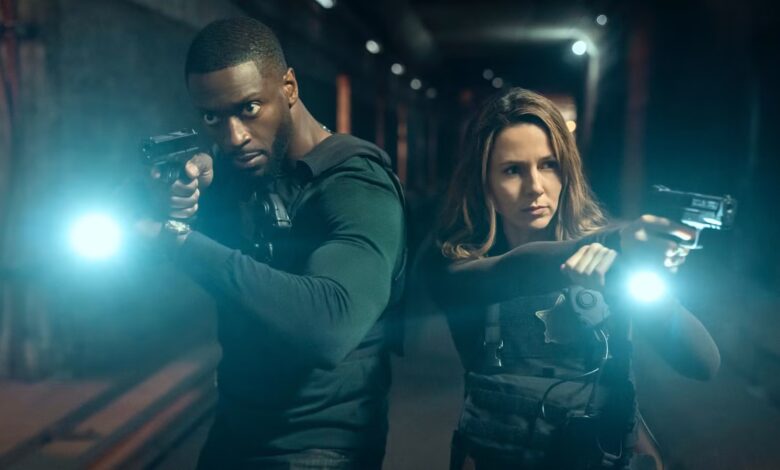
Other thrillers on the platform use personal loss to provide an immediate emotional anchor. The 2024 series Cross, featuring Aldis Hodge as James Patterson’s famous detective Alex Cross, begins with a moment of domestic normalcy that is shattered by gunfire. Cross and his wife Maria are enjoying a meal when an attack leaves Maria fatally wounded. She dies in her husband’s arms, transforming the show from a forensic psychology procedural into a personal war. This visceral opening justifies the character’s intelligence and barely contained anger throughout the investigation.
A similar ‘stranger in town’ hook is employed in Reacher (2022–Present). Adapting Lee Child’s novels, the series introduces Alan Ritchson as Jack Reacher, a former military police investigator. The show begins with the dark, messy disposal of a body before cutting to the daylight arrival of Reacher in Margrave, Georgia. His simple desire for a slice of peach pie is interrupted when he is surrounded by police and arrested for the murder shown moments earlier. This immediate transition from a crime to the arrest of an unassuming drifter serves as a classic narrative engine for the mystery that follows.

Prime Video has also leaned into genre-bending openers that establish unique world-building. Into the Badlands (2015–2019) introduces a post-apocalyptic world without guns, defined by martial arts and feudal politics. The first scene features Daniel Wu as Sunny, a warrior riding a motorcycle through a field of red poppies. This striking visual contrast turns grim when he finds an overturned slave transport surrounded by bodies, immediately signaling the brutality of the world Sunny inhabits. Similarly, the opening of The Boys (2019–2026) subverts the superhero genre. After a seemingly heroic intervention by Homelander and Queen Maeve, the premiere delivers a shock when the speedster A-Train accidentally runs through a civilian, killing her instantly. This moment, staged by director Dan Trachtenberg, exposes the lethal gap between corporate superhero marketing and reality.
In military-focused dramas like Tom Clancy’s Jack Ryan (2018–2023) and The Terminal List (2022–Present), the first scene serves to establish the scope of the threat. Jack Ryan begins with a failed CIA operation in the Middle East that informs the financial trail Ryan eventually uncovers. The Terminal List, starring Chris Pratt as James Reece, starts with a catastrophic ambush in a Syrian tunnel system. The chaotic collapse of the mission, involving explosions and failing communications, leaves Reece as one of the few survivors and sets the stage for a season-long conspiracy investigation.
Finally, the 2024 reimagining of Mr. & Mrs. Smith uses its opening to underscore the danger of the profession. Before introducing leads Donald Glover and Maya Erskine, the show features a brief sequence with another ‘John and Jane Smith’ played by Alexander Skarsgård and Eiza González. Their quiet evening is interrupted by a lethal ambush, establishing early on that in this world of high-stakes espionage, professional competence does not guarantee safety.