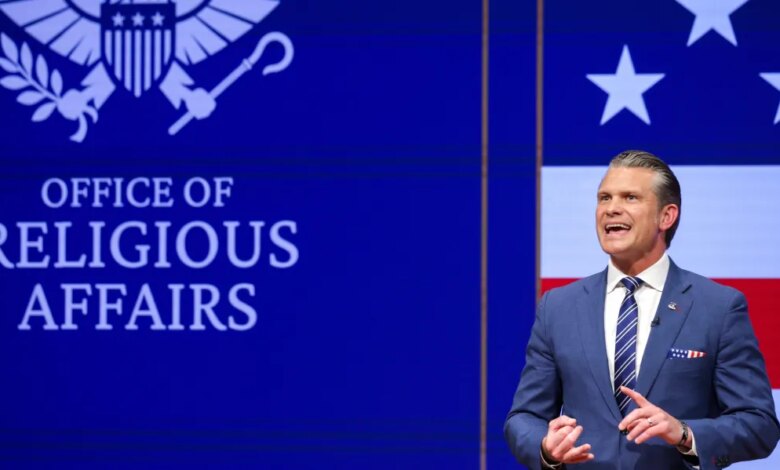
Defense Secretary Pete Hegseth has established a new Office of Religious Affairs within the Pentagon, promising a direct line of communication for the military’s religious leaders. However, a growing cohort of current and former military chaplains are signaling that they do not want the closer relationship, warning that the move threatens the pluralistic nature of the armed forces and risks framing state conflicts as religious crusades.
Announced on September 30, the new office is intended to provide the chaplain corps with access to the Secretary of Defense without what Hegseth described as “bureaucratic dilution.” The office’s director will report directly to Hegseth and the deputy defense secretary, overseeing the Armed Forces Chaplains Board and coordinating with civilian organizations that endorse military clergy. The office is also tasked with assessing “spiritual fitness,” “spiritual readiness,” and “spiritual resilience” across the military services.
Critique of the move has been swift from within the ranks. An active-duty Army captain currently serving as a non-Christian chaplain expressed fear that the office would be used to institutionalize a specific religious agenda. “We should not be in the business of wrapping the state’s mission in one particular religion,” the chaplain said, speaking on the condition of anonymity due to fears of retaliation. He warned that once a military mission is framed as “God’s will,” the ethical checks on armed conflict are eroded, as “every act inside it is sanctified in advance.”
The creation of the office follows the rollout of Hegseth’s “Send Me” campaign, an initiative promoted by the Pentagon that utilizes the biblical verse Isaiah 6:8. While the Pentagon describes the campaign as a recruitment effort focused on volunteers, scholars of religion have noted that the use of the verse—traditionally a call to preach a warning of judgment to one’s own people—is being repurposed as a call to military service. During a 9/11 memorial speech at the Pentagon, Hegseth described the “struggle against evil” as a conflict that “will continue until Judgment Day,” specifically referencing the current tensions with Iran.
Concerns regarding Hegseth’s personal religious and political messaging have shadowed his tenure. The Secretary’s tattoos include a Jerusalem cross on his chest and the Latin phrase “Deus vult” (God wills it) on his bicep. The latter, a cry from the medieval Crusades, has been adopted by various far-right extremist groups. In 2021, these symbols led a fellow National Guard member to flag Hegseth as a potential security threat, resulting in his removal from an assignment protecting the inauguration of Joe Biden.
Rev. Dr. Rebekah Savage, a former military chaplain who oversees clergy endorsements for the Unitarian Universalist Association, stated that her organization was not consulted before the office was established. She indicated that her concerns are shared by many within the chaplaincy corps. This tension follows a June letter sent by Savage and 10 other religious endorsers objecting to revisions of the military’s Religious Affiliations Code list. The signatories argued those changes obscured the identities of religious communities including historically Black churches, Wiccans, Pagans, and Unitarian Universalists.
“Classification is resource allocation,” the June letter stated, suggesting that changes to how religions are categorized directly impact access to clergy and the distribution of chaplaincy resources. The anonymous Army chaplain echoed this, questioning whether funding for faith-based homeschooling and suicide-prevention programs would be distributed equitably or directed primarily toward Christian organizations.
Pentagon press secretary Kingsley Wilson defended the new office, stating that it was created to protect the constitutional rights of service members to practice their faith without coercion. She noted that religious activities remain voluntary. “The Christian faith is woven deeply into the fabric of our nation and shared by America’s wartime leaders like President George Washington and President Franklin D. Roosevelt,” Wilson said, adding that Hegseth is among those who embrace this heritage despite efforts to remove it.
On October 17, 2026, Hegseth continued his outreach during a “Send Me” tour event for ROTC cadets at the University of Tennessee in Knoxville. However, for those within the chaplaincy, the fusion of state power and religious rhetoric raises fundamental questions about their role in advising commanders.
“If my role as a chaplain is to advise soldiers and commanders of issues of morality and ethics, what can I say to them now?” the active-duty chaplain asked. He raised the specter of moral injury, noting the difficulty of counseling service members who may believe an action is immoral but are told it has been ordained by a god they may not even worship. “What can I say to a non-Christian soldier who is being ordered to kill his fellow man or risk dying himself for a god he does not believe in?”