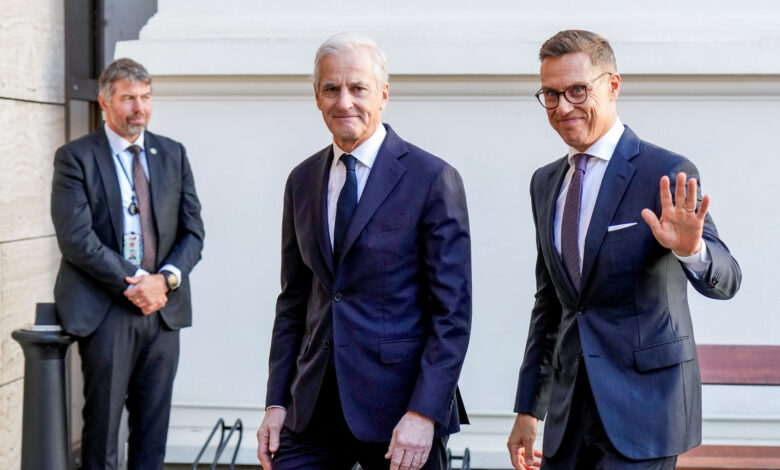
In a significant departure from the prevailing Western policy of diplomatic isolation, the leaders of Finland and Norway engaged in a direct, 90-minute telephone conversation with Russian President Vladimir Putin on Tuesday. The outreach by Finnish President Alexander Stubb and Norwegian Prime Minister Jonas Gahr Stoere marks the first time in months that European leaders have bypassed established barriers to communicate directly with the Kremlin regarding the war in Ukraine.
The high-stakes call was followed immediately by a separate discussion between the two Nordic leaders and Ukrainian President Volodymyr Zelenskiy. In a joint statement, Stubb and Stoere linked their diplomatic initiative to upcoming peace discussions scheduled to take place between Russian, Ukrainian, and U.S. officials in Abu Dhabi next month. Those talks will be the first of their kind since February, occurring at a moment when the geopolitical landscape is shifting rapidly.
Stubb characterized the discussion with Putin as “frank and substantive,” emphasizing that Finland and Norway occupy a unique position as neighboring countries to Russia. He argued that the direct impact of the war on Northern European security necessitated a seat at the negotiating table. “Ending the war requires direct discussions,” Stubb stated, while Stoere noted that they had specifically pushed Putin on the importance of immediate de-escalation.
This diplomatic pivot comes as European capitals express growing anxiety over the direction of U.S. foreign policy under President Donald Trump. Recently, Washington has shifted its posture in favor of Moscow, resulting in U.S.-Ukraine relations hitting their lowest point in 18 months. This shift has been punctuated by concrete policy changes, including a deal this month for Putin to supply Russian diesel to the United States and a simultaneous easing of U.S. sanctions on Russia. At the same time, Kyiv has reported significant disruptions to U.S.-provided intelligence-sharing and the satellite internet services that the Ukrainian military relies upon for battlefield operations.
The Kremlin’s account of Tuesday’s call suggested little movement in Russia’s fundamental requirements for a settlement. According to the Russian readout, Putin insisted that a “just and long-term peace” is only possible if the “legitimate interests of the Russian Federation” are fully addressed. The Kremlin also used the opportunity to criticize EU and NATO countries, accusing them of pursuing confrontational policies that prolong hostilities.
Russian Foreign Minister Sergei Lavrov was even more dismissive, suggesting the call offered no new solutions and was merely an attempt by European nations to insert themselves into a negotiation process they have been excluded from. A source close to the Kremlin added that Putin informed the Nordic leaders that any end to the war must take into account “realities on the ground,” a reference interpreted as Russia’s refusal to compromise on its goal of capturing the entire Donbas region.
Despite the skepticism from Moscow, the move was welcomed by some in Kyiv. Ukrainian Foreign Minister Andrii Sybiha confirmed the call had been coordinated with his government and described it as “the right approach.” He expressed hope that the diplomatic activity could support a localized ceasefire around the Russian-occupied town of Oleshky, which he said might pave the way for broader peace steps.
However, the initiative has exposed divisions within Europe. Danish Prime Minister Mette Frederiksen voiced concern over the direct contact, stating she saw no evidence that Russia was genuinely seeking peace and urged European nations to “stick together rather than going solo.” Swedish Prime Minister Ulf Kristersson revealed that other European leaders had not been informed of the talks beforehand, adding that he maintained “quite low expectations” for the outcome. Polish Prime Minister Donald Tusk also signaled a need for “absolute caution and vigilance” when engaging with the Kremlin.
Defending their actions, Stubb and Stoere maintained they were acting in their capacity as heads of neighboring states rather than as representatives for the entire European Union, though they insisted they had consulted with partners. They may find support in Berlin, where German Chancellor Friedrich Merz called the Nordic role “very constructive.” Merz noted that Germany and other states are looking to establish a format for dialogue with Moscow, asserting that solutions to the conflict cannot be found without both Ukraine and European involvement.
While battle lines in Ukraine remain largely static despite an increase in long-range airstrikes this year, the diplomatic lines are clearly beginning to move. The Kremlin indicated that Putin, Stoere, and Stubb intend to keep in contact by phone as the road to the Abu Dhabi talks continues.