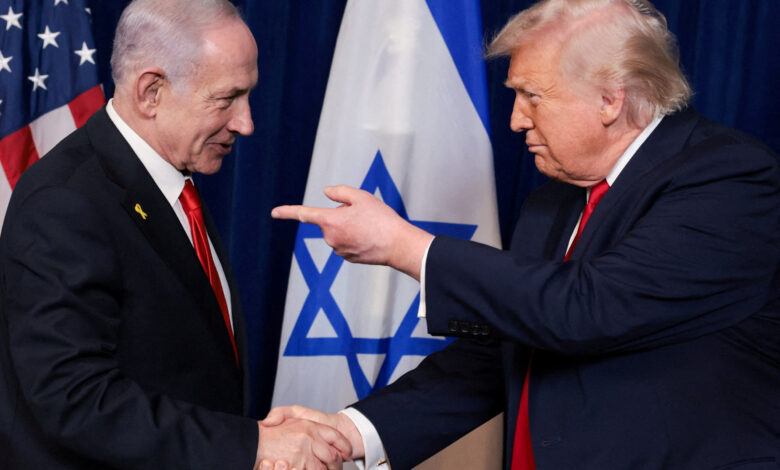
Prime Minister Benjamin Netanyahu boasted of an endorsement from U.S. President Donald Trump on the eve of Israel’s national election, suggesting that the two leaders could restart their military campaign against Iran if he remains in office.
Speaking in a televised appearance late Sunday night, Netanyahu praised the U.S. leader’s backing. U.S. President Donald Trump has come with a friendship that has never existed before between an Israeli prime minister and an American president, and it is doubtful we will ever have such a friendly president again, Netanyahu said, noting that Trump has another two years in his term and is calling on voters to support his continued premiership.
In a social media post on Sunday, Trump urged voters to back the incumbent prime minister. Vote for Bibi Netanyahu for Prime Minister, we have to finish the job that we started, wrote Trump, who launched the joint Iran war with Netanyahu in February. Netanyahu asserted that Trump was willing to take action to finally remove the Iranian threat, provided Netanyahu stays in power. Netanyahu added that he has already instructed the Mossad and the Israel Defense Forces to bring down the regime, describing it as the only way to end the threat.
The White House did not immediately respond to requests for comment regarding the remarks. Meanwhile, Netanyahu’s leading opponent, centrist former military Chief of Staff Gadi Eisenkot, addressed the endorsement on social media, praising Trump as a true friend of Israel while emphasizing confidence that the U.S. leader will work in full cooperation with whichever leader the Israeli people choose.
Tuesday’s vote marks Israel’s first general election since the October 7, 2023, Hamas attacks, providing voters with their initial opportunity to deliver a verdict on the severe security failure and the subsequent multi-front wars. Operating at the head of the most right-wing government in Israeli history, Netanyahu presides over a political landscape that has drifted further to the right. Nearly all Jewish-led parties, including Eisenkot’s faction, now oppose the two-state solution that anchored decades of peace negotiations with Palestinians.
Polls indicate that Netanyahu’s Likud Party may lose seats, potentially stripping his coalition of right-wing, far-right, and ultra-Orthodox parties of its narrow majority. However, Eisenkot and a coalition of opposition parties spanning from the center-left to the right lack a clear path to unseating him. At 77 years old, Netanyahu has established a record of political survival, having returned to power 18 months after a brief ouster that required four inconclusive elections over two years to achieve.
Neither side planned major public events for Monday, instead utilizing social media to amplify their core campaign messages. Netanyahu argued that he remains the only leader with the resolve to confront Israel’s adversaries, while opponents contended that his divisive politics have left the country vulnerable. Netanyahu shared an artificial intelligence-generated video on Monday depicting Iran’s Supreme Leader Ayatollah Mojtaba Khamenei—whose father, Ali Khamenei, was killed during the opening night of U.S.-Israeli strikes in February—lying in a hospital bed and declaring that his own vote would be against Netanyahu to avoid meeting his father prematurely. On Sunday, Netanyahu also posted a computer-generated image of a mushroom cloud over Tel Aviv to illustrate existential threats from Iran.
Eisenkot criticized the digital campaign strategy, accusing his opponent of relying on fear-mongering, lies, and threats, including the depiction of nuclear bombs in the center of Tel Aviv, which he stated would not work this time.
Trump’s endorsement carries distinct political risks as well, arriving just a week before a U.S. legislative election where congressional Republicans are fighting to maintain their majorities. The conflict with Iran remains deeply unpopular across the United States, where critics attribute a spike in consumer prices and fuel costs to the hostilities. Major combat operations have been suspended for months following ceasefire negotiations conducted without Israeli participation.