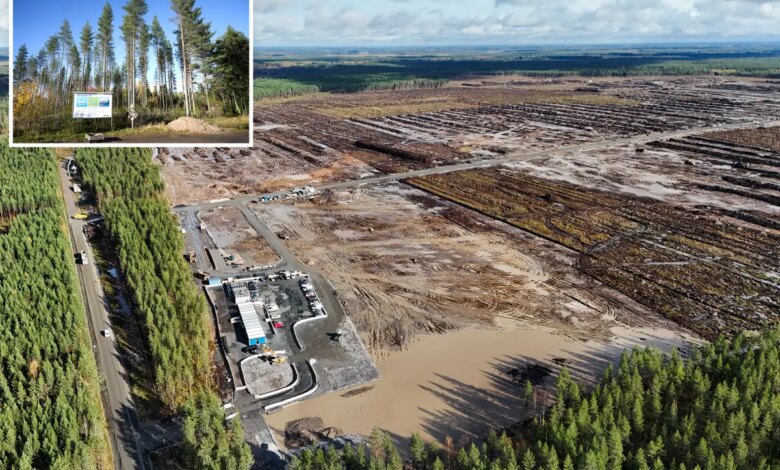
Google’s ambitious $15 billion expansion into the Nordic artificial intelligence infrastructure market has encountered a severe legal and environmental setback in Northern Finland. The technology giant is accused of illegally demolishing an estimated 250,000 trees to make way for massive data center complexes, transforming hundreds of acres of forest into a barren mud wasteland before securing the necessary regulatory approvals.
The large-scale clearing took place outside the rural town of Muhos, located southeast of Oulu, and at a second site near Kajaani, roughly 90 miles away. In total, Google’s project subsidiary, Tuike Finland Oy, cleared approximately 816 acres of woodland. Under Finnish law, companies are strictly required to complete a mandatory Environmental Impact Assessment (EIA) before commencing such large-scale land operations. Officials say Google bypassed this requirement, leading to a direct intervention by national regulators.
The Finnish Licensing and Supervision Agency has ordered a full suspension of development at both sites, effective until at least October 23, 2026. The pause is intended to allow authorities to assess the damage already inflicted on the local ecosystem. Tommi Muilu, head of the agency’s environmental department, stated that the extensive preparatory measures—including tree removal, topsoil stripping, and the alteration of ditches and culverts—have already fundamentally changed the environment. According to Muilu, the identification and assessment of these impacts are central objectives of the EIA procedure that Google allegedly ignored.
Local residents and conservationists have expressed fury over the destruction, which they claim has had immediate consequences for both the environment and public safety. The removal of the vast forest canopy has displaced local wildlife, most notably driving packs of wolves into the village of Otanmäki, located 50 miles from the clearing, as they search for new food sources. Resident Anni Ranta reported that wild animals fled the site in mass, forcing predators into human-populated areas. Ranta also voiced concerns over the acoustic impact of the project, noting that the hard rock soil in the region amplifies construction noise to a sound she compared to a drum.
The environmental degradation extends to the local water table. Aerial images and ground reports show the once-forested land is now a grid of tire tracks and muddy puddles. Runoff from the stripped land has turned nearby water sources brown, polluting streams that feed into the Oulujoki River. Vesa Hyyryläinen, a local conservationist, questioned why the region was being forced to sacrifice so much of its natural landscape for tech infrastructure, suggesting that the permissions for such projects are often granted too easily.
Antti Jakonen, another Muhos resident, criticized the company’s approach as being conducted in an aggressive “American style” that lacked sense. He called on the tech giant to provide restitution to the community, perhaps by helping to restore local salmon populations that were decimated by hydropower developments in previous decades. Beyond environmental concerns, some residents expressed geopolitical anxieties, fearing that high-value data infrastructure could become a target for regional aggression given the current tense political climate in Europe.
Hanna Halmeenpää, chair of the Finnish Association for Nature Conservation (SLL), characterized the company’s actions as “pure arrogance.” She argued that the firm simply purchased the land and began cutting without regard for local statutes. Critics suggest the company may have been rushing to establish its facilities before Finnish legislation could catch up with the rapid advancements and regulatory needs of the AI industry.
In response to the suspension and local outcry, Google’s top chief in Finland, Antti Järvinen, claimed the company initially believed it had the legislative approval required to begin the work. Järvinen has since apologized for the destruction. The company has pledged to take steps to protect local water sources and has committed to a replanting effort covering approximately 321 of the cleared acres.
The controversy in Finland mirror growing global resistance to the rapid expansion of massive data centers required to power AI. This pushback has seen various forms of regulatory intervention elsewhere; for instance, New York recently issued an executive order pausing permits for “hyperscale” data centers to assess their impact on the state’s electrical grid and environment. As Google attempts to navigate the Finnish suspension, the site remains a stark landscape of mounds of dirt and muddy tracks, a physical testament to the friction between the global AI race and local environmental preservation.