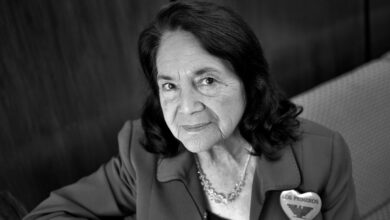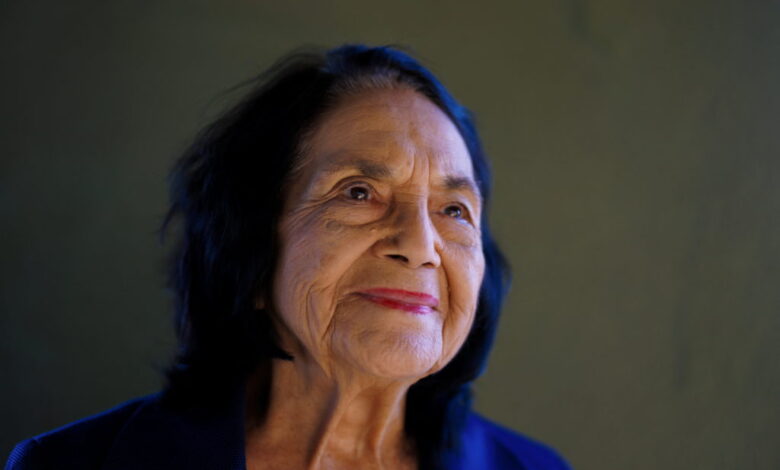
Dolores Huerta, whose tireless organizing reshaped labor rights and civil rights in the United States and who coined the enduring rallying cry “Sí, se puede!”, has died at the age of 96. Her family announced in a statement released through her foundation that she passed away Wednesday at her home.
Born Dolores Clara Fernandez in 1930 in Dawson, New Mexico, Huerta moved to California with her mother and brothers after her parents divorced when she was three. Immersed in a diverse San Joaquin Valley community of working-class families, she was inspired by her mother, a business owner who instilled in her a strong sense of independence and social consciousness. Huerta initially worked as an elementary school teacher, but grew deeply frustrated seeing her students come to class hungry and without proper shoes. That early distress prompted a career shift.
In the early 1960s, her civil rights work in Stockton brought her into contact with César Chavez. Sharing a vision to improve conditions for agricultural laborers, the pair co-founded the National Farm Workers Association in 1962, which later became the United Farm Workers of America. Huerta served as a key leader, negotiator, and strategist for the union. She participated directly in the historic five-year Delano Grape Strike alongside Filipino grape pickers, negotiated foundational collective bargaining agreements with major growers, and secured the first health and benefit plans for farmworkers.
Her activism extended beyond the fields and into legislative halls and national politics. Huerta successfully lobbied for disability insurance and financial assistance for unemployed California workers, fought against toxic pesticides, pushed for immigrant amnesty, and challenged federal guest worker programs. By organizing nationwide boycotts of grapes and lettuce in the 1970s, she generated the economic and political pressure necessary for California to pass the nation’s first state law recognizing farmworkers’ right to collective bargaining.
Over decades of demonstrations, Huerta was jailed 22 times. In 1988, while protesting then-Vice President George H.W. Bush’s opposition to the UFW grape boycott in San Francisco, she was struck by a police officer’s baton. The impact left her with three broken ribs and a pulverized spleen, requiring more than a dozen blood transfusions and a lengthy recovery before she eventually reached a legal settlement with the city.
Her political engagement also intertwined with tragedy. While volunteering on Robert F. Kennedy’s 1968 presidential campaign and registering Mexican American voters in California, Huerta stood on stage with Kennedy moments before he was assassinated. Later in life, she actively campaigned for Democratic presidential nominees Bill Clinton, Barack Obama, and Joe Biden.
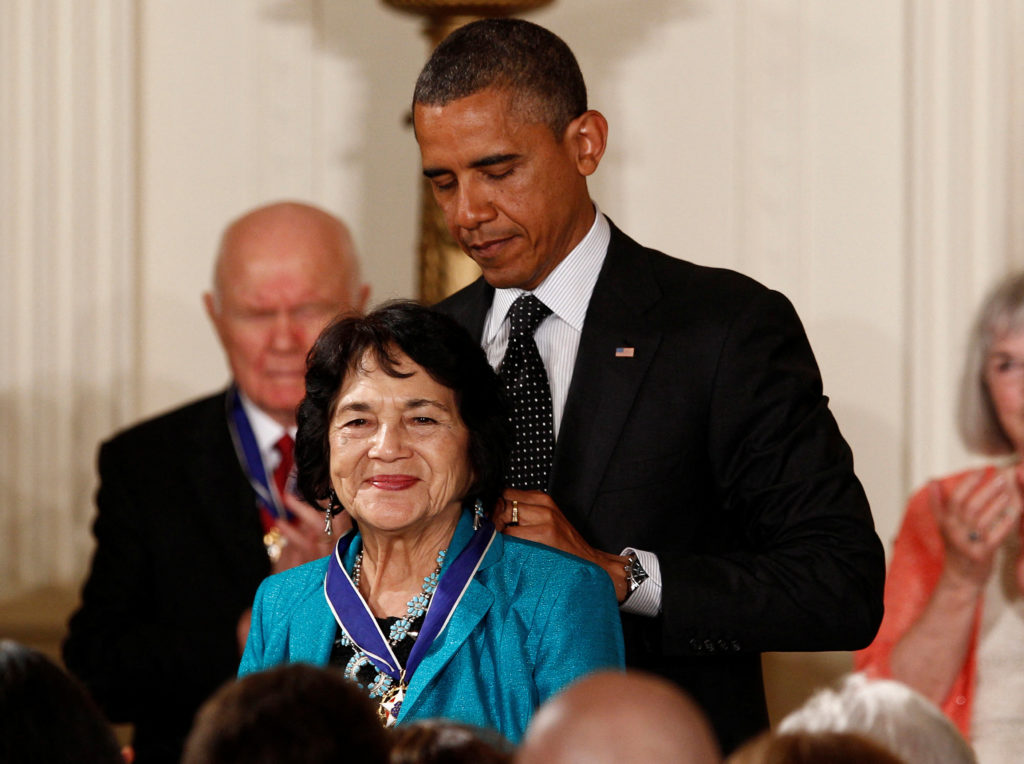
Her numerous accolades included the Presidential Medal of Freedom, awarded by President Barack Obama in 2012, and induction into the National Women’s Hall of Fame as the first Latina honoree. Schools, murals, and streets across multiple states bear her name.
In her later years, Huerta maintained a demanding schedule, speaking and marching on behalf of her Bakersfield-based foundation for race, poverty, LGBTQ+, and women’s rights. Earlier this year, she publicly disclosed that she had been sexually abused in the 1960s by César Chavez, resulting in the birth of two children—a secret she kept for six decades to protect the farmworker movement. From the early 1970s until his death, her life partner was Richard Chavez, César’s brother, with whom she had four children, alongside seven children from two previous marriages.
Throughout her life, Huerta viewed her activism as a moral duty. Reflecting on her legacy in a 2025 documentary, she expressed a simple wish for future generations. We want to give our children an inheritance of justice, she said, not jewels or property or money.