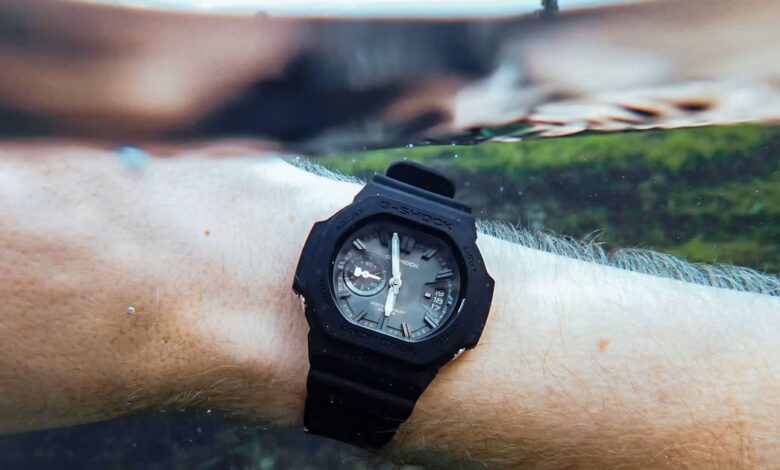
Casio has officially taken the wraps off its latest affordable watch line, introducing the G-Shock 2500 series. Having circulated previously through preliminary leaks originating in Japan, the new models have quickly earned the nickname “CasioNaut” among enthusiasts due to the case geometry echoing high-end integrated sports watches. Ahead of its official November 7 market launch, hands-on reviews of test examples have revealed a timepiece that combines vintage-inspired mechanical aesthetics with unexpected quartz complications.
Priced starting below A$300 for the resin models, the 2500 series breaks from contemporary trends by offering a fully analog display devoid of digital screens, LCD panels, or Bluetooth connectivity. The dial features a simple two-handed central time display paired with a small seconds subdial and a date window. Underneath the exterior lies Casio’s proprietary Shock Release Hand system, which debuted earlier on the GA-V01 in April 2025. This mechanism uses magnets instead of a conventional mechanical post to hold the minute hand in place, allowing it to absorb heavy impacts and snap back into alignment automatically if jolted.
The standout engineering achievement of the 2500 series centers on the new QW-5757 quartz module. Casio has engineered the date wheel to serve a dual function. When the watch is switched into stopwatch mode via the pusher located at 8 o’clock, the central hour and minute hands continue normal timekeeping, while the small seconds hand resets to zero. Simultaneously, the date wheel rotates to display “ST” behind the zero position. Activating the pusher at 4 o’clock sets the seconds hand in motion, while the date wheel clicks over to zero to track elapsed stopwatch minutes. The mechanism is programmed to take the shortest rotational path forward or backward to reach the stopwatch indicator.
Reviewers testing both the classic resin models and the stainless steel variants found the unique physical digital readout remarkably legible during outdoor activities such as trail running. Case dimensions vary slightly between configurations, with the resin models measuring 44mm across and 12mm in thickness, while the steel versions measure 43mm by 13mm. Despite those substantial paper specifications, the case design tapers around the protective ears to accommodate pushers, allowing the watch to wear smaller on the wrist than typical chunky G-Shock models.

However, the design introduces distinct practical limitations. Because the dual-function date wheel relies on numerical positions up to 31, the stopwatch function halts abruptly at 31 minutes and 59 seconds. This ceiling restricts its utility for timing longer athletic events or extended water activities, despite the watch carrying a 200-meter water resistance rating. Furthermore, pushers are rendered inactive while submerged, and an 80s-style orange LED backlight positioned in the rehaut between the 6 and 7 o’clock markers suffers from shadows cast by tall hour indices, limiting its illumination across the dial.
Bracelet and strap configurations also present a mixed experience. The steel models feature full-width link designs integrating into the case through a fixed endlink that extends the overall lug-to-lug measurement to 57.5mm. While the use of standard spring bars makes resizing straightforward, it introduces noticeable gaps between links and a looser feel on the wrist compared to screw-links or pin-and-collar systems. The pressed-steel folding clasp offers three micro-adjustment points.

The lineup spans multiple material combinations and price tiers. The entry-level GAC-2500 in resin is priced at A$289, followed by the GMC-2500 hybrid stainless steel model on a resin strap at A$459, and the top-tier GMC-2500D featuring a full steel case and integrated bracelet at A$599.