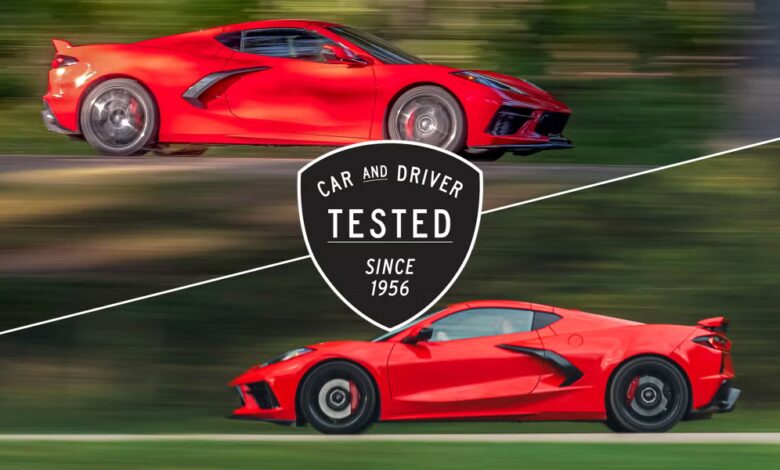
The 2027 Chevrolet Corvette Stingray has undergone a significant heart transplant, replacing its long-standing 6.2-liter LT2 engine with the larger and more potent LS6 6.7-liter V-8. This upgrade brings a meaningful jump in output, adding 40 horsepower and 50 pound-feet of torque to the mid-engine sports car’s repertoire. With a total of 535 horsepower at 6,100 rpm and 520 pound-feet of torque at 4,600 rpm, the latest Stingray officially crosses the 200-mph threshold, a benchmark it now offers at a base price point below $75,000.
Performance evaluations conducted on the 2027 model, specifically the 1LT trim equipped with the Z51 Performance Package, show a car that is faster in almost every measurable category compared to the original C8 launched for the 2020 model year. The 2027 Stingray achieved a 0-60 mph time of 2.7 seconds, shaving one-tenth of a second off the 2020 model’s performance. As speeds climb, the displacement advantage of the 6.7-liter engine becomes more apparent. The new Corvette reaches 100 mph in 6.9 seconds and 150 mph in 18.6 seconds, beating the older 6.2-liter model by 0.3 seconds and 0.8 seconds, respectively.
The quarter-mile performance further cements the 2027 model’s superiority in a straight line. It clocked a time of 11.0 seconds flat with a trap speed of 124 mph, compared to the 11.2-second run at 122 mph recorded by the earlier C8 platform. This improved acceleration is supported by a port and direct fuel injection system and an aluminum block and heads design.
Interestingly, the top speed of the Corvette is dictated by its aerodynamic and mechanical configuration. While the base Stingray is capable of hitting the 200-mph mark, opting for the $5,395 Z51 Performance Package actually lowers the top speed to 183 mph. This reduction is attributed to several factors inherent to the track-focused package, including increased aerodynamic drag from the front splitter and rear wing, and larger cooling ducts for the braking system. Crucially, the Z51 package utilizes a shorter 5.56:1 final-drive ratio—shared with the high-performance Z06—which optimizes low-end acceleration at the expense of terminal velocity.
Beyond sheer speed, the 2027 Corvette has grown slightly in mass. The tested unit weighed in at 3,702 pounds, making it 55 pounds heavier than the 2020 comparison vehicle. This additional weight likely contributed to a marginal decrease in lateral grip; the new car pulled 1.02 g on the skidpad using Michelin Pilot Sport S5 tires, whereas the 2020 car managed 1.03 g on previous-generation Pilot Sport 4S rubber. Braking performance remained largely consistent, with both generations requiring 149 feet to stop from 70 mph. At 100 mph, the 2027 car showed a slight improvement, stopping in 297 feet compared to the 301 feet required by the older model.
The auditory character of the Corvette has also shifted with the introduction of the LS6. The larger V-8 is considerably more vocal, measuring 53 decibels at idle, which is 6 dBA louder than the 2020 version. Under full throttle, the engine produces 96 decibels, up from the 92 decibels of the 6.2-liter unit. Despite this increased aggression under load, engineers have managed to keep the cabin slightly more composed during highway travel, with cruising noise levels dropping by one decibel to 73 dBA at a steady 70 mph.
This increased performance and sound come with a small trade-off in efficiency. The 6.7-liter engine is rated at 18 mpg combined, representing a 1-mpg drop across all EPA categories. The city rating stands at 15 mpg, while highway efficiency is rated at 25 mpg.
The 2027 Corvette Stingray 1LT starts at $73,795, though the model utilized for performance data was priced at $101,095. This increase was driven by approximately $30,000 in options, including the $11,750 3LT package, which adds premium leather, a 14-speaker Bose audio system, and a head-up display. Other notable additions included Magnetic Ride Control ($1,895), a quad center-exit exhaust system ($1,995), and the Z51 package featuring an electronically controlled limited-slip differential and upgraded cooling.