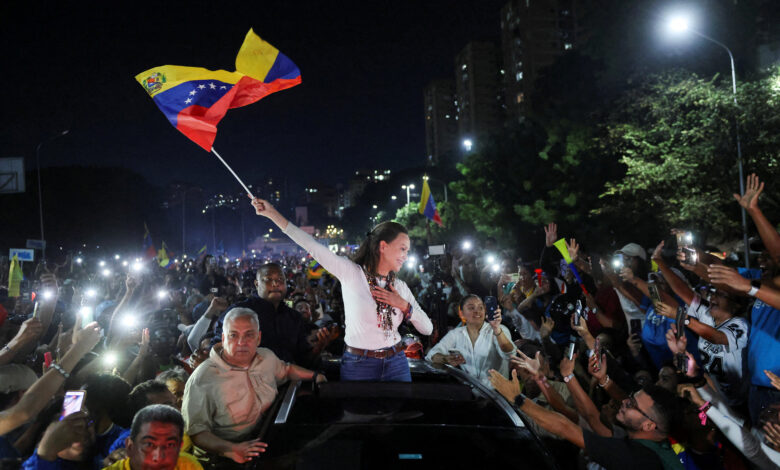
Venezuelan opposition leader Maria Corina Machado returned to the country on Sunday after nearly a year abroad, setting the stage for a tense political balancing act as she pushes for rapid elections while managing relations with a US-backed negotiation process.
Machado’s homecoming, following several failed attempts, included a public appearance in Barquisimeto before traveling by road to Caracas. Tens of thousands of supporters swarmed her caravan, waving Venezuelan flags, chanting her name, and draping her with rosaries. Supporters hailed her as the country’s next president and pressed for a presidential vote, which Machado has argued should take place in 2027.
However, her return risks complicating ties with the administration of US President Donald Trump. While Washington acknowledged her right to be in Venezuela, it has endorsed acting President Delcy Rodriguez and backed an ongoing negotiation process between the Rodriguez government and opposition groups that excludes Machado’s Vente Venezuela movement.
The talks aim to overhaul the electoral council and top court ahead of future elections. Both bodies are currently staffed by ruling party loyalists and backed ousted President Nicolas Maduro in the disputed 2024 presidential election, despite vote tallies published by Machado’s movement indicating her candidate had won. The Trump administration captured Maduro in January.
US Secretary of State Marco Rubio stated on Sunday that Machado’s safe return was a direct outcome of the negotiations, adding that he expects all political actors to support the ongoing talks. US President Trump stated on Sunday that he had been unaware of her return plans, though a person briefed on her movements disputed that claim. Last month, Trump remarked that it was too soon to consider democratic elections.
Acting President Rodriguez, speaking during a visit to a military hospital in Caracas, said she hopes the dialogue will encourage those who called for international sanctions against the country to feel remorse. She urged politicians to focus on serious matters rather than staging a public show, adding that the talks provide an opportunity for all voices seeking the nation’s good to be heard.
Political analysts suggest Machado’s push for immediate results could test the United States’ three-phase stabilization, recovery, and transition plan for Venezuela. Ricardo Rios, head of the political risk consultancy Poder y Estrategia, noted that the current negotiations focus on holding regional elections before a presidential vote. He emphasized that the viability of the transition still hinges on defining guarantees for the ruling sector to relinquish power if defeated.
Phil Gunson, senior analyst for the Andes region at the International Crisis Group, warned that the massive public reception could intensify demands for instant results. Such pressure could provoke hardline government factions or potentially trigger a political rupture rather than a peaceful transition if post-electoral guarantees remain inadequate.
Meanwhile, other opposition factions participating in the talks, led by 2015-elected lawmaker Dinorah Figuera, described Machado’s return as a meaningful step within the broader US framework. Oswaldo Ramirez, managing director of ORC Consultores, noted that Machado’s trajectory will depend on how she reads signals from Washington, which has emphasized reconstruction and reconciliation. He added that she must operate within the parameters of the current diplomatic process.