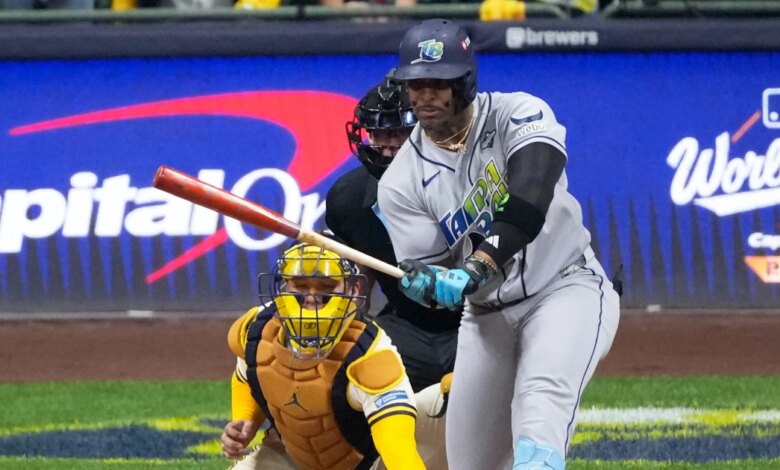
The Milwaukee Brewers stand just two victories away from securing the first World Series title in franchise history, aided by a razor-thin and fiercely contested umpire ruling Saturday night.
With the Brewers protecting a 5-4 lead in the top of the ninth inning, the Tampa Bay Rays threatened with a runner on third base and two outs, putting designated hitter Yandy Díaz at the plate. Facing a 3-2 count on an offering from relief pitcher Aaron Ashby, Díaz attempted to check his swing against a breaking ball that appeared destined to miss the zone for ball four.
Home plate umpire Jim Wolf initially ruled that Díaz had successfully checked his swing, which would have awarded him a base on balls and extended the inning. However, Milwaukee catcher William Contreras immediately appealed to first base umpire Jordan Baker, who judged that the batter had broken the plane and committed to a swing. The resulting strikeout brought an abrupt end to the contest, sealing the narrow victory for the Brewers.
Replays offered conflicting perspectives on the play, leaving both players and managers to grapple with the umpire’s discretion. Díaz acknowledged his disagreement with the decision in postgame comments while conceding that the ruling stood. Tampa Bay manager Kevin Cash noted that from his vantage point on the bench, the swing appeared to have occurred.
The decisive moment thrust a long-standing officiating gray area back into the national spotlight. Major League Baseball’s official rulebook does not contain a formal definition for a checked swing, leaving umpires to evaluate whether a pitch was “struck at” based entirely on field judgment rather than fixed geometric standards. While colloquial understanding often centers on breaking an imaginary plane, the lack of an explicit rule forces officials to rely on subjective evaluation.
Tampa Bay was unable to challenge the call because checked swings are excluded from MLB’s expanded replay review rules, which have permitted managers to contest plays like force outs, tag incidents, and fan interference since 2014. Although the league introduced the automated ball-strike system this season to review balls and strikes, the technology does not extend to checked-swing determinations.
The controversy has renewed discussions regarding the potential implementation of electronic oversight for subjective judgment calls. MLB tested checked-swing challenges during the 2024 Arizona Fall League utilizing the same Hawk-Eye technology deployed in the ABS system, evaluating whether a batter’s bat crossed a 45-degree threshold from home plate. That technology subsequently expanded to minor league play, reaching the single-A Florida State League in 2025 and the Triple-A Pacific Coast League.
Addressing the timeline for major league adoption in June 2025, MLB Commissioner Rob Manfred emphasized the league’s measured approach to integrating new automated systems. Manfred noted that officials preferred to establish the primary ABS framework before introducing the added complexity of a secondary challenge system operating simultaneously during an at-bat.